July 20, 2026


- Home
- Services
- Resume Example
- Resume Review
- Reverse Recruiting
- BlogJuly 19, 2026July 18, 2026July 17, 2026July 16, 2026July 15, 2026July 14, 2026July 13, 2026
- Contact Us
New Zealand Resume Writing Services Guide 2025

Get A Professional Resume Review

Get A Professional Resume Services

Get in Touch With Experienced Writer
Home » ATS Resume » New Zealand Resume Writing Services Guide 2025
New Zealand Resume Writing Services Guide 2025
New Zealand's job market has its own rhythm — smaller talent pools, tighter industry networks, and hiring managers who often know your previous employers by name. A resume that performs in the US or UK doesn't automatically land interviews in Auckland or Wellington. The conventions, expectations, and ATS landscape here are genuinely different.
This guide covers what NZ employers specifically look for on a resume, how the local market differs from the US and UK, what good NZ resume writing services actually do, and how to evaluate your options — whether you write it yourself or get professional help.
Already have a resume? Get a free ATS scan to see how it scores against NZ employer keyword filters.
Scan my resume free →The NZ job market
What makes the New Zealand market different
5M
people across the entire country — making New Zealand one of the smallest developed job markets in the world. That scale changes everything: hiring managers at mid-size NZ companies often know your previous employer's management team personally. Your reputation travels faster. Your resume needs to reflect that context.
The practical implications for job seekers are significant. In the US, a resume is primarily an ATS-optimisation exercise — pass the algorithm, then impress a human. In NZ, many roles — especially at the senior and specialist level — involve direct human review from the first application. The network is tight enough that a strong reputation can open doors a resume wouldn't, but a poorly written resume can close them just as fast.
That said, large NZ employers — government agencies, listed companies, and major corporates like Fonterra, ANZ, Air New Zealand, and Spark — do use ATS at volume. Mid-market and SME roles are more likely to go straight to a hiring manager's inbox. Your resume needs to be built for both.
NZ resume conventions
What NZ employers specifically expect
New Zealand sits between the US and Australian conventions, with a few distinctly local norms:
✓ Standard in NZ
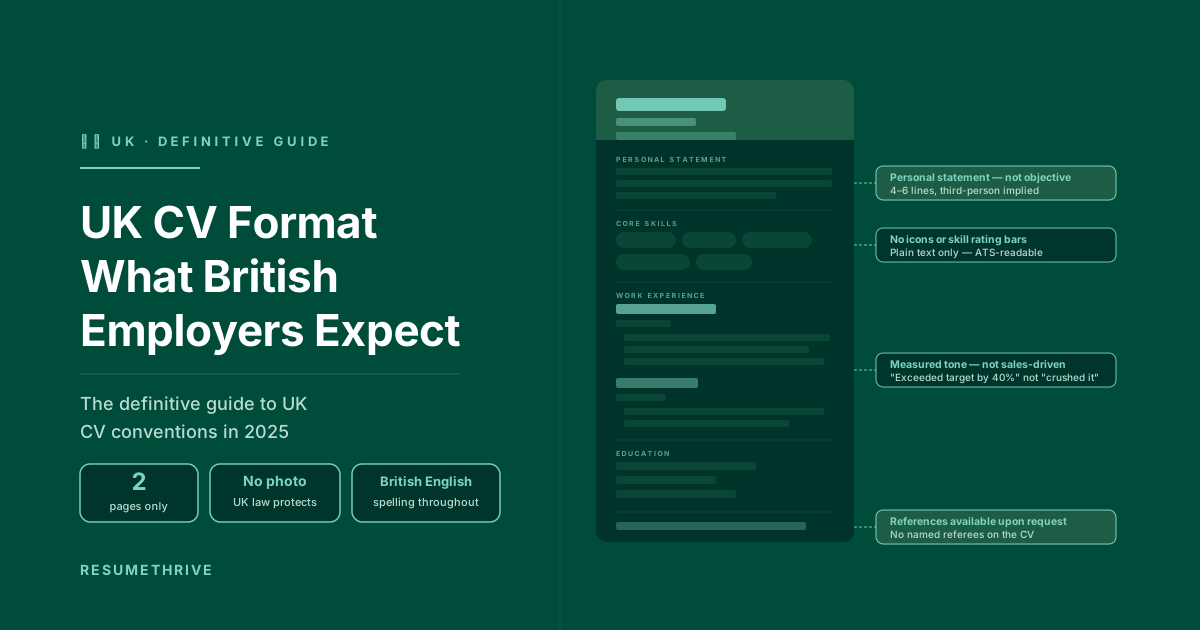
- 2–3 pages for most professional roles
- Professional summary or profile at top
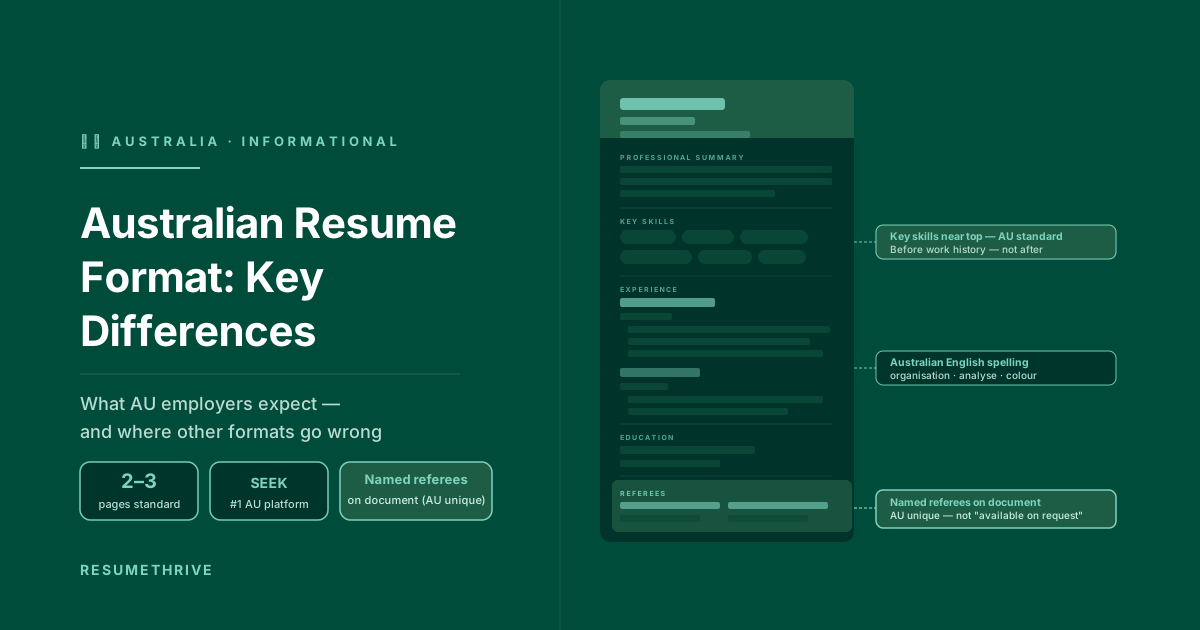
- Referees listed (2–3 named contacts)
- Skills section before work history
- Salary expectations sometimes requested
- Cover letter still expected with most applications
- LinkedIn URL increasingly standard
✕ Not expected in NZ
- Photo (not standard; not recommended)
- Date of birth or marital status
- Elaborate graphic design or infographic formats
- US-style 1-page resume (reads as undercooked)
- Academic-CV length (10+ pages for industry roles)
- Objective statements (use a profile instead)
One NZ-specific note on referees: unlike the US (where "references available on request" is standard) and more like Australia, NZ employers expect named referees on the resume itself — typically two professional contacts. Include their name, title, company, phone, and email. Not having this section signals unfamiliarity with the local market.
Keywords and ATS
ATS in the New Zealand market
The ATS landscape in NZ is less saturated than in the US but growing fast among larger employers. The platforms most commonly used by NZ organisations include Workday, PageUp, and SEEK's own ATS integration. If you're applying through SEEK — which handles the majority of NZ job listings — your resume will often pass through an ATS layer before human review.
NZ-specific keywords that matter for ATS matching:
NZQA qualification
NZ citizen / permanent resident
WorkSafe
SEEK profile
Te Tiriti awareness
bi-cultural
kiwi
iwi
ACC
IRD
MYOB / Xero
NZD revenue
FTE managed
For roles in the public sector, local government, DHBs (now Te Whatu Ora), or education, expect additional screening for cultural competency language — particularly around Te Tiriti o Waitangi, tikanga Māori, and working in bicultural or multicultural environments. These terms aren't tokenistic additions; they're genuine screening signals for a large segment of the NZ job market.
Free ATS resume scanner
See how your resume scores for the NZ market
Upload your resume and get a keyword gap report against the NZ role you're targeting — in 60 seconds, no sign-up required.
Get my free ATS score → Free · No sign-up · Results in 60 secondsWhat to look for in a service
How to evaluate NZ resume writing services
The NZ resume writing market is small enough that the quality gap between providers is significant. A service that works well for Australian or US applicants won't necessarily understand the referees section expectation, the bicultural context of public sector roles, or the SEEK-specific formatting conventions that NZ hiring managers are used to seeing.
-
They understand the NZ-specific conventions
Does the writer know that 2–3 pages is standard here, that named referees are expected, and that a cover letter is still required for most professional NZ applications? If a service is producing US-style 1-page resumes for NZ applicants, that's a red flag — regardless of how polished the output looks.
-
They conduct a real intake process
A proper NZ-market resume requires understanding your visa status (citizen, resident, or work visa), your industry-specific experience, and whether you're targeting Auckland, Wellington, Christchurch, or regional roles — all of which affect how the document should be positioned. A service that skips this with a generic intake form is producing generic output.
-
They know SEEK formatting
The majority of NZ job applications go through SEEK. A writer who understands how SEEK's ATS parses resumes — clean formatting, clear section headers, no embedded tables or graphics — gives you a structural advantage before a human ever sees the document.
-
They can write for the public sector if needed
Government and public service roles represent a significant portion of the NZ professional market — particularly in Wellington. These roles often screen explicitly for competency-based language, bicultural awareness, and specific public sector frameworks (e.g. the NZPS Code of Conduct). Not every resume writer knows this environment.
-
They show real before/after samples
Ask for NZ-specific samples — not US or UK examples repurposed for a local audience. A sample should show the correct structure (profile, skills, experience, education, referees), NZ salary and company context, and outcome-driven bullets appropriate for the local market.
Not sure if your resume is formatted correctly for NZ employers? A free ATS scan takes 60 seconds.
Scan my resume free →Pricing
What NZ resume writing services cost in 2025
| Level | Local NZ services | ResumeThrive |
|---|---|---|
| Graduate / entry-level | NZ$250–$450 | from NZ$249 |
| Mid-level professional | NZ$400–$700 | from NZ$299 |
| Senior / management | NZ$600–$1,100 | from NZ$399 |
| Executive / C-suite | NZ$1,000–$2,500+ | from NZ$599 |
| Turnaround time | 5–10 business days typical | 3–5 business days |
| NZ market expertise | Varies widely by provider | NZ-specific conventions included |
Common mistakes
NZ resume mistakes that cost interviews
-
⚠️
No referees section. NZ employers expect named referees on the resume itself. Leaving this out — or writing "references available on request" — signals you haven't read the local market.
-
⚠️
A 1-page resume. Fine for US applications, unusual in NZ. A 1-page resume for a professional with 5+ years of experience reads as incomplete, not concise.
-
⚠️
No cover letter. NZ hiring managers still read cover letters, particularly at SMEs. Skipping it signals effort — the wrong kind.
-
⚠️
No visa or work rights statement for non-residents. If you're on a work visa, or if your residency status is unclear from your name or background, adding a clear statement — "NZ permanent resident" or "currently on an open work visa" — removes a common early-stage rejection reason.
-
⚠️
US-style salary negotiation framing. NZ salary discussions are more reserved than in the US. If asked for salary expectations, provide a range — don't anchor aggressively or leave it completely blank.
Final check
NZ resume checklist before you apply
Run through this before every NZ application
- Document is 2–3 pages — not 1, not 4+
- Professional profile (not objective) at the top — 4–6 lines, written for the target role
- Skills section appears before work history
- Referees section at the end: 2–3 named contacts with title, company, phone, and email
- Work rights clearly stated if not a NZ citizen
- Cover letter prepared — tailored to the specific role and employer
- Public sector roles include bicultural/Te Tiriti language where genuinely relevant
- Applied through SEEK? Checked formatting parses cleanly without tables or graphics
- Bullet points lead with outcomes and numbers, not tasks
One last step
Check your resume against NZ market standards — free
Our free ATS scanner checks keyword coverage, formatting, and structure against the NZ role you're targeting — so you know exactly what to fix before you apply through SEEK or direct.
Get my free ATS score → Free · No sign-up · Instant results