July 20, 2026


- Home
- Services
- Resume Example
- Resume Review
- Reverse Recruiting
- BlogJuly 19, 2026July 18, 2026July 17, 2026July 16, 2026July 15, 2026July 14, 2026July 13, 2026
- Contact Us
What’s the Difference? (USA, UK, AU)

Get A Professional Resume Review

Get A Professional Resume Services

Get in Touch With Experienced Writer
Home » ATS Resume » What’s the Difference? (USA, UK, AU)
What’s the Difference? (USA, UK, AU)
The resume vs CV question trips up more job seekers than almost any other — especially people applying internationally. In the USA, "CV" is often used casually to mean resume. In the UK and Australia, they're genuinely different documents with different conventions. Get it wrong and you look like you didn't research the market.
This guide breaks down exactly what each document is, which countries use which terminology, when the distinction actually matters, and how to format correctly for each market — USA, UK, and Australia.
Have a resume or CV already? Check it against the right ATS filters for your target market.
Scan my resume free →The core difference
Resume vs CV — what actually separates them
2 vs 10+
pages — the most practical difference between a resume and a full academic CV. A resume is a targeted, concise document (1–2 pages) tailored to a specific role. A CV is a comprehensive career record with no page limit, designed to document everything you've ever done professionally and academically.
The word "curriculum vitae" is Latin for "course of life" — which tells you everything about the intent. A CV isn't designed to be concise. It's designed to be complete. A resume, by contrast, is designed to make a case: here is why I am the right person for this specific role, in the fewest possible words.
| Factor | Resume | CV (Academic / Intl.) |
|---|---|---|
| Length | 1–2 pages maximum | 2–10+ pages, no strict limit |
| Purpose | Targeted pitch for one specific role | Complete record of career and scholarship |
| Tailoring | Customised per application | Updated over time; rarely role-specific |
| Publications | Not included (unless academic) | Full publications list expected |
| Photo | Never in USA; sometimes in EU | Common in EU, Middle East, Asia |
| Personal details | Name, contact, LinkedIn only | May include DOB, nationality, languages |
| Where it's standard | USA, Canada (industry roles) | UK/AU (called "CV"), EU, academia globally |
By country
What each market actually expects
🇺🇸
United States
- Always called a "resume" for industry roles
- "CV" only used in academic/research contexts
- 1 page (0–5 yrs) or 2 pages (5+ yrs)
- No photo, no DOB, no marital status
- ATS-first: formatting must parse cleanly
- Tailored per role — one generic doc won't cut it
🇬🇧
United Kingdom
- Called a "CV" but functions like a US resume
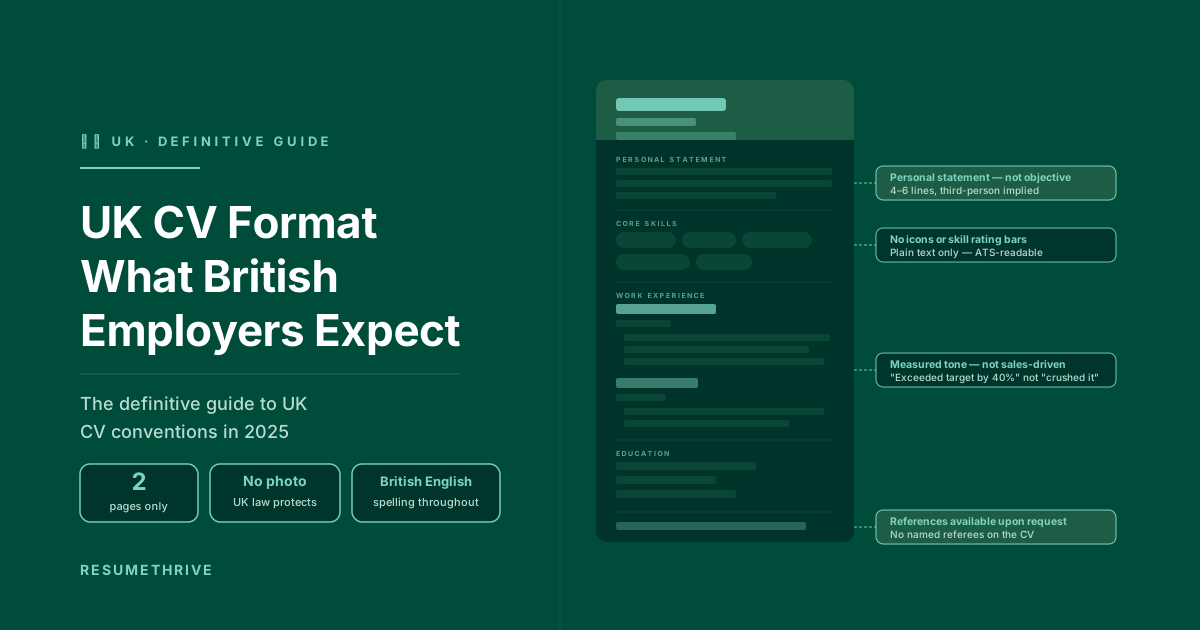
- 2 pages is the standard — not 1, not 3
- No photo (illegal to request in hiring)
- Personal statement (summary) at the top
- References section: "Available on request"
- Less ATS-heavy than US; human-read first
🇦🇺
Australia
- Called a "resume" or "CV" interchangeably
- 2–3 pages standard; slightly more detail than US
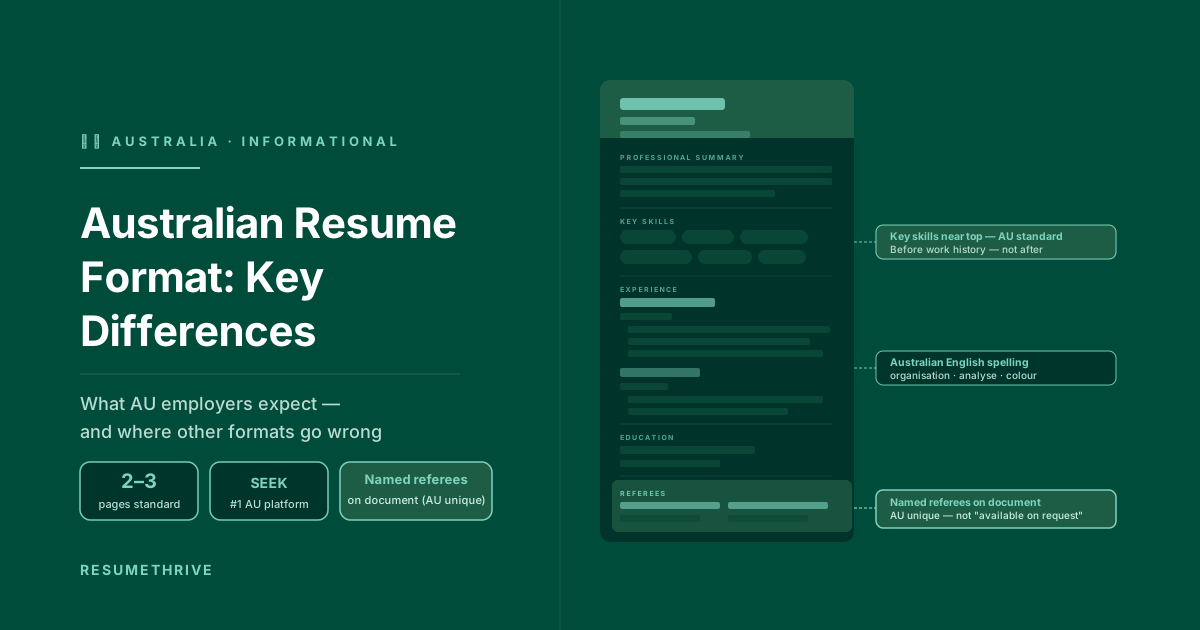
- Referees section expected (2–3 named contacts)
- Professional summary near the top
- Key skills section common before work history
- ATS screening used by large employers
Free ATS resume scanner
Check your document against the right market
Whether it's a US resume, UK CV, or Australian application — our free scanner checks keyword coverage, formatting, and ATS-readability for your target role.
Get my free ATS score → Free · No sign-up · Results in 60 secondsWhen to use which
Resume or CV — how to decide
-
Applying for an industry or corporate role anywhere
Use a resume. Even in the UK and Australia — where the document is called a "CV" — what employers actually want is a concise, targeted, 2-page document that looks and functions like a US-style resume. When a UK job posting says "send your CV," they mean: 2 pages, personal statement up top, clean formatting, no photo.
-
Applying for an academic, research, or fellowship role
Use a full CV everywhere — USA included. Academic hiring committees expect a complete record: publications, conference presentations, teaching experience, grants, awards. A 1-page resume submitted to a faculty search reads as a misunderstanding of the process.
-
Applying to roles in Europe, the Middle East, or Asia
Norms vary more significantly here. Many European countries expect a photo and a fuller personal profile (Europass format is common). Middle Eastern and some Asian markets may expect DOB, nationality, and marital status — details that would never appear on a US or UK document. Always research the specific country norm before applying internationally.
-
Applying to a role that asks for a "CV" in the USA
In a US corporate context, "CV" and "resume" are often used interchangeably by job postings — even incorrectly. Unless the role is explicitly in academia, medicine, or research, submit a 1–2 page targeted resume. Sending a 10-page academic CV for a marketing role signals you misread the room.
Format differences
How the document structure changes by market
🇺🇸 US Resume structure
- Contact info (no photo, no DOB)
- Professional summary (3–5 lines)
- Core skills / keywords
- Work experience (reverse-chronological)
- Education
- Certifications (if relevant)
🇬🇧 UK CV structure
- Contact info (no photo)
- Personal statement (4–6 lines)
- Work experience (reverse-chronological)
- Education and qualifications
- Skills / technical competencies
- "References available on request"
🇦🇺 AU Resume structure
- Contact info (no photo)
- Professional summary
- Key skills section
- Work experience (reverse-chronological)
- Education and qualifications
- Referees (2–3 named, with contact details)
📚 Academic CV structure
- Contact info and institutional affiliation
- Research interests / academic profile
- Education (full degrees listed)
- Publications (peer-reviewed, books, chapters)
- Conference presentations and grants
- Teaching experience and service
Applying to the UK or Australian market? Run a free scan to check your document structure and keyword match.
Scan my resume free →Common mistakes
The formatting mistakes that signal the wrong market
Common cross-market errors
Sending a 1-page US-style resume to a UK employer — reads as under-prepared; they expect 2 pages with a personal statement.
UK application: 2-page CV with a 4-line personal statement, references section, and qualifications listed in full (A-levels, degree, grade).
Including a photo on a US resume — raises discrimination concerns and signals unfamiliarity with the market.
US resume: name and LinkedIn URL only — no photo, no DOB, no nationality, no marital status.
Sending a 10-page academic CV for a corporate role in the US because the posting said "CV."
US corporate role: 1–2 page targeted resume, regardless of what the job posting calls it.
Quick reference
Resume vs CV — the one-minute decision guide
Use this to decide which document to send
- Applying in the USA for an industry/corporate role → 1–2 page resume, no photo, ATS-formatted
- Applying in the UK for any industry role → 2-page CV (functions as a resume), personal statement at top, no photo
- Applying in Australia → 2–3 page resume/CV, named referees at end, key skills section near top
- Applying for any academic, research, or fellowship role → full CV with publications, no page limit
- Applying in Europe → research country-specific norms; Europass format common in EU member states
- Not sure which the employer wants → check their careers page or job posting language; if it still says "CV" in a US corporate context, send a resume
One last step
Make sure your document is right for your target market
Our free ATS scanner checks keyword coverage, structure, and formatting — whether you're applying in the US, UK, or Australia — in 60 seconds.
Get my free ATS score → Free · No sign-up · Instant results