July 20, 2026


- Home
- Services
- Resume Example
- Resume Review
- Reverse Recruiting
- BlogJuly 19, 2026July 18, 2026July 17, 2026July 16, 2026July 15, 2026July 14, 2026July 13, 2026
- Contact Us
How Long Do Recruiters Spend Reading Your Resume?

Get A Professional Resume Review

Get A Professional Resume Services

Get in Touch With Experienced Writer
Home » ATS Resume » How Long Do Recruiters Spend Reading Your Resume?
How Long Do Recruiters Spend Reading Your Resume?
"Recruiters only spend 7 seconds on your resume." You've probably read that line. It's been quoted in career advice columns for a decade, cited in hiring studies, and used to justify everything from shorter summaries to bigger fonts. It's also only part of the story.
The 7-second figure is real — it's the average initial scan. But what happens in those 7 seconds, which resumes get more time, and exactly where recruiters look first are the parts that actually determine whether your resume gets a callback or a quiet archive. This is what the research actually shows — and what it means for how you structure your document.
Find out in 60 seconds whether your resume passes the initial scan — keyword match, format, and structure.
Scan my resume free →What the data actually says
The 7-second study — and what it doesn't tell you
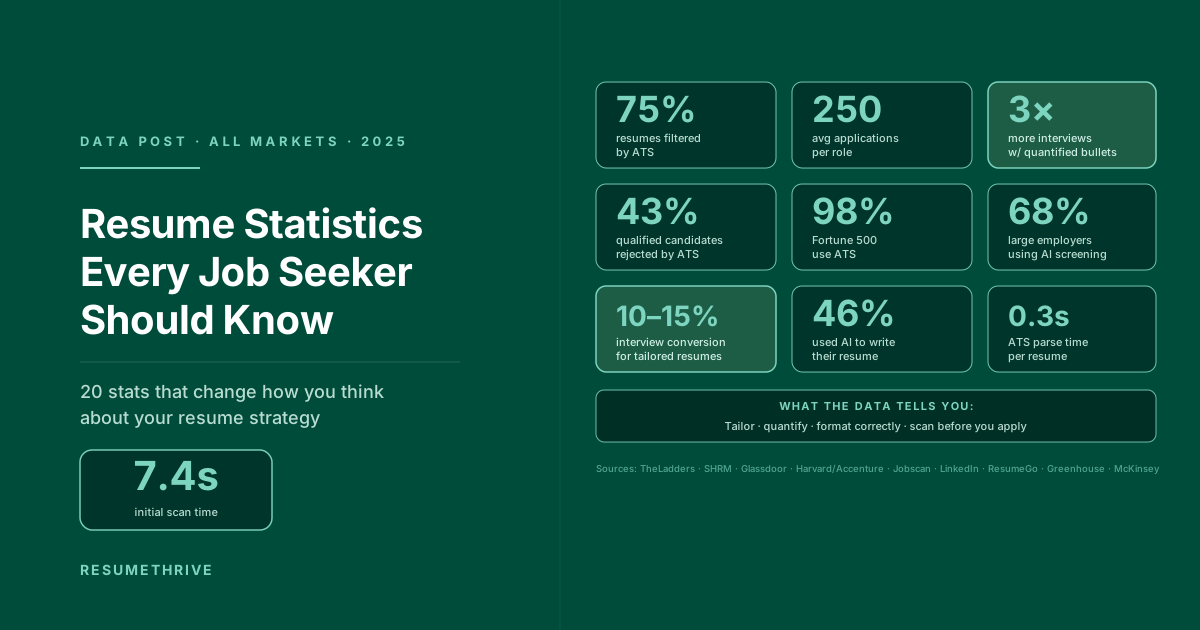
7.4sec
average initial review time in the most-cited eye-tracking study of recruiter behaviour, conducted by TheLadders. But that same study found that resumes which passed the initial scan received significantly longer review — averaging over 4 minutes in the follow-up read. The 7 seconds is a gate, not a verdict.
The study used eye-tracking software to follow exactly where recruiters looked during that initial scan. The findings were striking: recruiters spent 80% of their total scan time on just six data points. Everything else on the page — the bullet points, the accomplishments, the summary prose — was largely ignored in the first pass.
Those six data points were: name, current job title, current employer, dates of employment, previous job title, and education. That's it. Everything else on the resume earns its reading time only if those six elements pass the filter.
Where eyes actually go
The recruiter scan pattern — second by second
-
10–1 sec
Name and contact block
Recruiters confirm the document is a resume and register the candidate's name. Nothing is evaluated yet — this is orientation. A cluttered header with graphics, icons, or a photo adds cognitive load and wastes this second.
-
21–3 sec
Current role and employer
This is the first real filter. Recruiters are asking: is this person roughly in the right world? A current job title that signals the right seniority and domain extends the read. A confusing or irrelevant title ends it. This is why a strong professional summary placed immediately below the header pays dividends — it gives context before the recruiter reaches the work history.
-
33–5 sec
Employment dates and tenure
Gaps, very short tenures, or an unexpectedly long gap since the last role all register here — and all trigger a mental flag that either slows the read or ends it. Dates are one of the few things that recruiters register instinctively, even on a fast scan. Clean, consistent formatting matters.
-
45–7 sec
Education and previous role
The final filter of the initial scan. Education level is checked — usually for a degree requirement or a relevant institution — and the previous job title is registered. If all four signals (current role, employer, tenure, education) are positive, the resume moves into the extended read pile.
-
57 sec → 4+ min
Everything else — if they get here
The bullet points, accomplishments, skills section, certifications, and summary prose that most candidates spend the most time writing. These only receive attention after the initial scan has already decided the resume is worth reading. Interesting statistic: resumes that survive the initial scan are read for an average of over four minutes. The details matter — but only once the filter is passed.
Free ATS resume scanner
See if your resume passes the first 7 seconds
Our free scanner checks the structure, formatting, and keyword signals that determine whether a resume makes it past the initial scan — before a human ever sees it.
Get my free ATS score → Free · No sign-up · Results in 60 secondsHot zones vs dead zones
Where recruiters look — and where they don't
Eye-tracking research consistently identifies a clear hierarchy of attention across a resume page. Understanding this changes which elements you invest time in and how you order them.
High attention
Top third of page one
Name, title, summary, and first job. Everything above the fold. This is where 80% of the initial scan lands.
High attention
Job titles (left margin)
Recruiters scan the left edge of the work history vertically, reading titles faster than the body of each role.
Medium attention
First bullet of each role
If the title passes the scan, the first bullet gets a read. Subsequent bullets receive less attention unless the first one hooks.
Medium attention
Education block
Checked for degree level and institution on the initial scan, then largely skipped unless the role specifies requirements.
Low attention
Page two
Receives significantly less time than page one. Older roles and supporting detail that don't fit page one should be trimmed, not continued.
Low attention
Skills lists and interests
Largely ignored in the scan phase. Skills sections matter for ATS keyword matching, not for human skim reads.
What this means for your resume
How to design your resume for the 7-second scan
-
Put your strongest signal at the top — always
The first thing a recruiter reads after your name sets the frame for everything that follows. A vague summary or a job title that doesn't match the target role wastes the most valuable real estate on the document. Your summary should state your role type, domain, and one headline achievement in the first two lines.
-
Make job titles do more work
Because titles are scanned vertically down the left margin, yours need to be immediately legible and relevant. If your official title is something internal and opaque — "Level 3 Operations Specialist" — consider whether adding a clarifying subtitle or functional title helps the recruiter understand your actual role faster.
-
Lead every role with your strongest bullet
The first bullet point under each job title gets read more than any other. Bury your headline achievement in bullet four and it won't be seen on the initial scan. Lead with your best number, your biggest project, your most relevant outcome — every time.
-
Remove everything that competes for attention in the header
Photos, icons, decorative lines, skill rating bars, and social media handles all add visual noise to the area that gets the most eye time. A clean header — name, title, phone, email, LinkedIn — loads faster in the recruiter's scan and leaves room for the content that actually matters.
-
Treat page two as supporting evidence, not primary content
If your most important experience, qualification, or achievement is on page two, it probably won't be seen on the initial scan. Ruthlessly edit page one to contain your best case. Page two supports it — older roles, additional certifications, early-career context.
Restructured your resume? Run a free ATS scan to confirm keyword coverage and formatting before you apply.
Scan my resume free →Common mistakes
What wastes the 7 seconds
-
⚠️
A generic summary that doesn't signal role fit in the first sentence. "Experienced professional with a passion for excellence" tells a recruiter nothing in the second they spend on the top of the page. State your role, domain, and a number — immediately.
-
⚠️
A two-column layout that breaks the natural left-to-right scan path. Recruiters scan left-edge job titles vertically. A sidebar column interrupts that path and forces extra cognitive work — exactly the wrong thing to do in a 7-second window.
-
⚠️
Burying the most relevant role below older jobs. Reverse-chronological order exists precisely because recruiters need to see what you're doing now, first. Any deviation from this — functional resumes, skills-first formats — risks hiding the most relevant signal behind the least relevant history.
-
⚠️
Dense paragraph-style descriptions with no white space. A wall of text signals reading time. Recruiters skip it. Short, scannable bullets with clear structure are read; paragraphs are skipped.
Final check
The 7-second self-test
Run this before every application
- Set a 7-second timer and hand your resume to someone unfamiliar with it — then ask them what role you're targeting and your strongest credential. If they can't answer, the top third isn't working.
- Your name, current/target title, and one headline achievement should all be visible without scrolling
- Every job title reads as immediately relevant to the target role — or has a clarifying subtitle
- The first bullet under each role leads with your strongest outcome, not a job description
- No photos, icons, rating bars, or decorative elements competing for attention in the header
- Page one contains everything a recruiter needs to decide you're worth reading further
- Dates are consistent and formatted cleanly — no unexplained gaps without context
One last step
Make every second of that scan count
Our free scanner checks keyword coverage, formatting, and the structural signals that determine whether your resume passes the initial filter — before a recruiter ever sees it.
Get my free ATS score → Free · No sign-up · Instant results