
July 20, 2026


- Home
- Services
- Resume Example
- Resume Review
- Reverse Recruiting
- BlogJuly 19, 2026July 18, 2026July 17, 2026July 16, 2026July 15, 2026July 14, 2026July 13, 2026
- Contact Us
Senior Software Engineer Resume: Full Guide 2025

Get A Professional Resume Review

Get A Professional Resume Services

Get in Touch With Experienced Writer
Home » ATS Resume » Senior Software Engineer Resume: Full Guide 2025
Senior Software Engineer Resume: Full Guide 2025
A senior software engineer resume isn't just a longer version of a mid-level one. The bar shifts — from showing what you built to showing what you owned, led, and influenced at scale. If your resume still reads like a list of technologies, it's costing you interviews.
This guide covers exactly how to position a senior SWE resume in 2025 — the structure, the keywords, the bullet point framework that turns code shipped into business impact, and the specific mistakes that get strong candidates filtered out before a recruiter sees their name.
Already have a resume? Run a free ATS scan and see your keyword match score in 60 seconds.
Scan my resume free →Senior vs. mid-level
What changes at the senior level
The most common mistake senior engineers make is submitting a mid-level resume with more years on it. Senior roles are evaluated differently — and ATS systems, hiring managers, and technical interviewers all screen for different signals.
| Element | Mid-level engineer | Senior engineer |
|---|---|---|
| Focus | Tasks completed and features shipped | Systems owned, architecture decisions, team influence |
| Bullet points | "Built X using Y" | "Designed and led X — reduced latency by 40%, unblocking 3 downstream teams" |
| Scale indicators | Feature scope | Traffic volume, system uptime, team size, cost savings |
| Leadership signals | Optional | Required — mentoring, code review, cross-functional collaboration |
| Resume length | 1 page (under 5 years) | 1–2 pages depending on experience depth |
| Summary tone | "Experienced developer with skills in…" | "Senior engineer with track record of delivering X at scale" |
6s
average time a technical recruiter spends on initial senior engineer resume review. The summary and first two bullet points determine whether they keep reading. Everything else is supporting evidence.
ATS keywords
Senior software engineer keywords for 2025
Languages and runtimes — list every one you use professionally:
Python TypeScript Go Java Rust C++ Kotlin Swift Ruby Scala
Infrastructure and architecture — the highest-signal senior-level keywords:
System design Distributed systems Microservices AWS Kubernetes CI/CD API design Docker Terraform GCP Azure PostgreSQL Redis Kafka GraphQL REST API gRPC
Process and leadership — these separate senior from mid-level in ATS scoring:
Technical leadership Code review Agile Scrum Mentoring Architecture review Cross-functional collaboration Technical roadmap On-call SLO / SLA Incident management
Free ATS resume scanner
See which senior SWE keywords your resume is missing
Upload your resume and get an instant keyword gap report — matched against the senior engineering role you're targeting.
Get my free ATS score → Free · No sign-up · Results in 60 secondsResume structure
How to structure a senior software engineer resume
-
Professional Summary — lead with scope and impact
Your summary needs to communicate seniority immediately. State your title, your years of experience, your primary stack, and one concrete signal of scale — a team size, a system you owned, or a metric you moved. Recruiters at top companies read hundreds of SWE resumes — "experienced software engineer with 8 years of experience" tells them nothing they can't infer from the dates.
Summary rewriteExperienced software engineer with 8 years building scalable web applications using modern technologies.Senior Software Engineer with 8 years building distributed systems at scale (Python, Go, AWS). Led backend architecture for a payments platform processing $2B+ annually — 99.99% uptime across 3 years. Currently mentoring a team of 4 engineers at Series B fintech. -
Technical Skills — flat list, no columns, no ratings
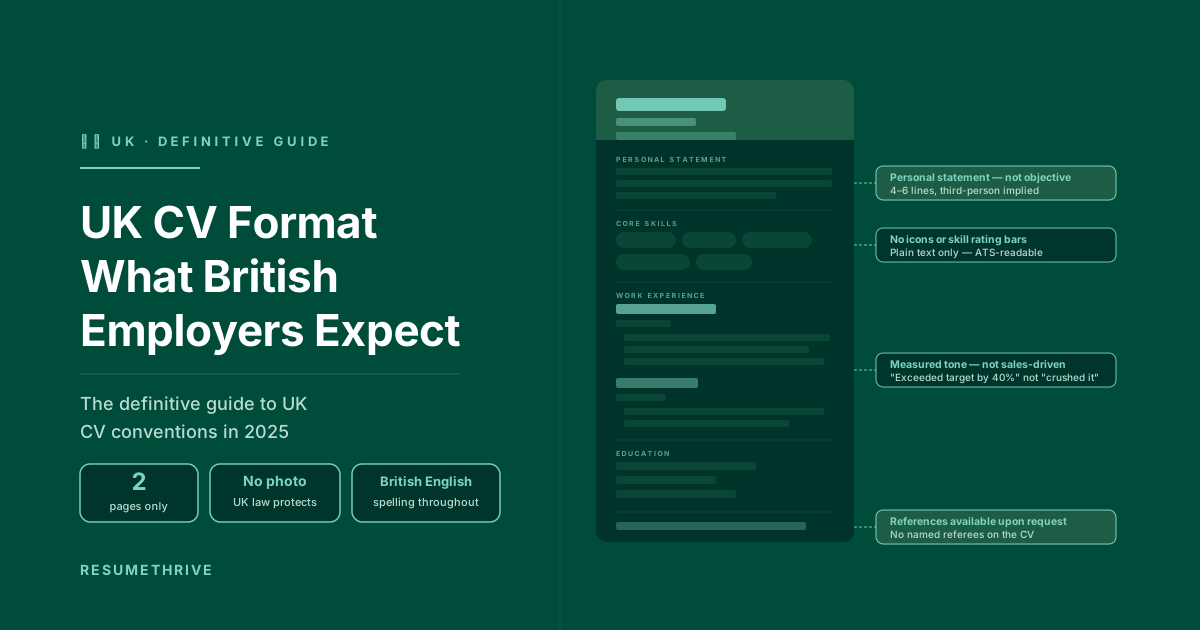
List every language, framework, cloud platform, database, and tool you use professionally. Organise into categories so ATS parsers and technical reviewers can scan efficiently. Never use skill rating bars — they're invisible to ATS and look dated to technical hiring managers.
Skills section formatLanguages: Python, Go, TypeScript · Cloud: AWS (Lambda, ECS, RDS, S3), GCP · Databases: PostgreSQL, Redis, DynamoDB · Infra: Kubernetes, Docker, Terraform, CI/CD · Frameworks: FastAPI, React, gRPC · Tools: Datadog, PagerDuty, GitHub Actions -
Work Experience — the STAR-Impact bullet framework
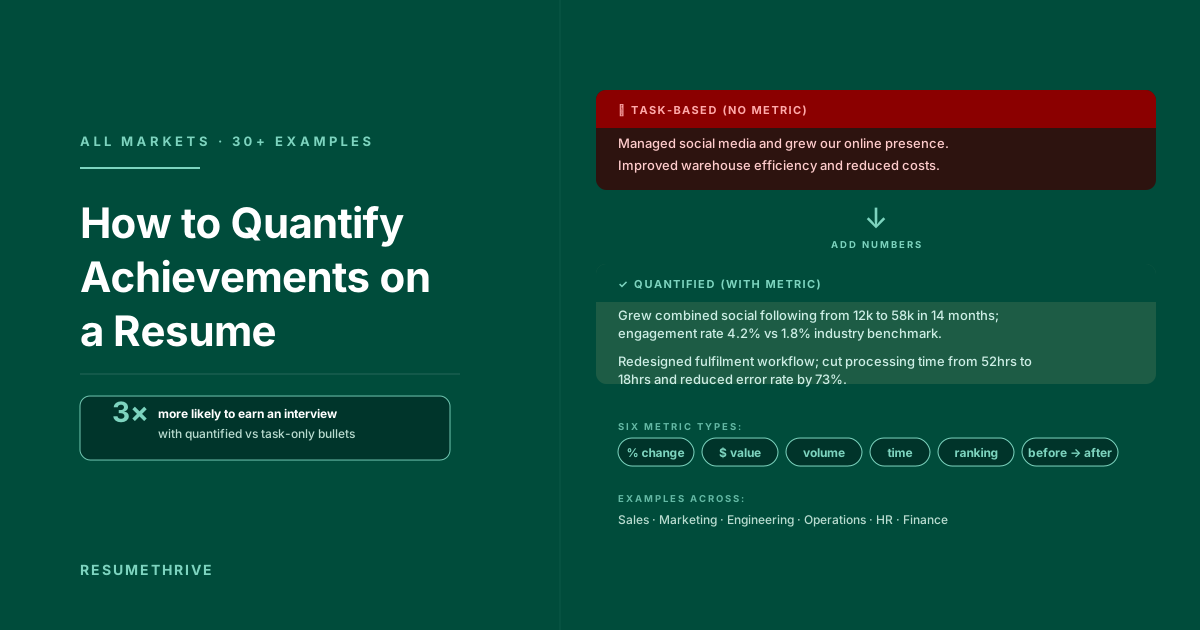
Senior engineer bullet points need to show what you built, the scale it operated at, and what it resulted in — for the business, not just for the codebase. A refactor that reduced latency is good. A refactor that reduced latency by 60% and cut infrastructure costs by $180K/year is a senior engineer bullet point.
Bullet rewritesWorked on microservices migration from monolith architecture.Led migration of 14-service monolith to microservices architecture (Go, Kubernetes) — reduced deployment frequency from monthly to daily, cutting time-to-production by 94% and enabling 3× feature velocity across 6 product teams.Improved performance of the data processing pipeline.Redesigned Kafka-based data ingestion pipeline processing 4M events/day — reduced end-to-end latency from 8.4s to 340ms and eliminated $220K in annual cloud spend through right-sizing and batching optimisations.Mentored junior engineers on the team.Mentored 3 junior and 2 mid-level engineers through weekly 1:1s and structured code review — two promoted to senior within 18 months. Established team-wide PR review guidelines adopted across 4 other engineering squads. -
Projects (optional but powerful)
A dedicated projects section works well for senior engineers who have built notable open source libraries, shipped side projects with meaningful traction, or led significant internal tooling initiatives. Include GitHub links where relevant — technical hiring managers will click them, and it signals confidence in your code quality.
-
Education
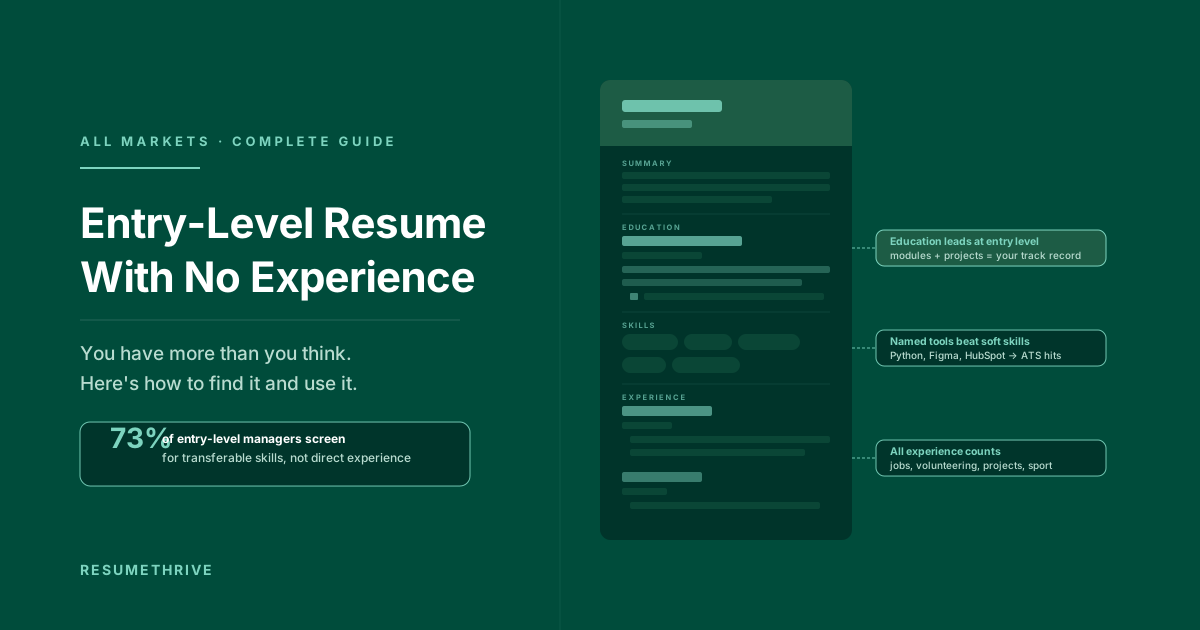
At the senior level, education is rarely the deciding factor. List degree, institution, and graduation year — that's all. If you're a bootcamp graduate with 6+ years of professional experience, your work history speaks louder than your education history. Don't shrink your experience section to expand education.
Common mistakes
What gets senior SWE resumes rejected
- ⚠️
Writing like a mid-level engineer. "Implemented feature X using React and Node.js" is a task description, not a senior-level achievement. Every bullet should answer: what was the scope, what was the impact, and who benefited beyond you?
- ⚠️
Listing every technology you've ever touched. A skills section with 60 items signals poor curation, not broad expertise. Prioritise the stack that matches your target role — depth beats breadth at the senior level.
- ⚠️
No leadership or mentoring signals. Senior engineer roles at most companies involve some degree of technical leadership, code review, and mentoring. A resume with zero mention of these signals reads as a strong individual contributor — not a senior engineer ready to multiply team output.
- ⚠️
Burying your most impressive work. If you led a system that serves 50 million users, that needs to be in your summary — not in the fifth bullet point of your second job. Senior engineers get hired on the strength of their most impressive work, not the average of all their work.
- ⚠️
Using a two-column or design-heavy template. Engineering resumes are parsed by ATS just like any other. A beautiful Canva template that lists your tech stack in a sidebar will have that sidebar scrambled or dropped entirely by most ATS parsers.
Done updating your resume? Scan it for free and see how it scores against ATS before you apply.
Scan my resume free →By company type
How the resume changes by employer
FAANG / Big Tech (Google, Meta, Amazon, Apple, Microsoft): Scale is everything. Numbers must be enormous — billions of requests, millions of users, hundreds of services. System design vocabulary (distributed systems, consistency models, sharding, observability) should appear prominently. Leadership and scope of influence matter as much as technical depth.
Series B–D startups: Velocity and ownership. Show that you can make decisions independently, ship quickly, and own entire systems rather than single services. Cross-functional work — collaborating with product and design, defining technical roadmaps — is highly valued. Breadth alongside depth.
Enterprise (banking, insurance, healthcare tech): Stability, compliance, and integration experience. Keywords like SOC 2, HIPAA, legacy system integration, and stakeholder communication appear more often as filters. Regulated environments want engineers who understand constraints, not just capabilities.
Remote-first companies: Async communication, documentation culture, and self-direction are increasingly screened for. Mention Notion, Confluence, ADRs (Architecture Decision Records), or written RFC processes if you have them — these signal fit for async-heavy environments.
Final check
Senior SWE resume checklist
Run through this before every application
- Summary states title, years, primary stack, and one concrete scale signal in the first two lines
- Technical skills section is flat, categorised, and free of rating bars or columns
- Every bullet point includes what was built, the scale it operated at, and a measurable outcome
- At least 2–3 bullets show leadership, mentoring, or cross-functional influence
- Most impressive work appears in the summary or first two bullets — not buried
- Stack keywords match the specific job posting's language
- Single-column layout, standard font, .docx or text-based PDF
- Run through ATS scanner before submitting
One last step
Check your senior SWE resume against ATS in 60 seconds
Our free scanner checks keyword coverage, formatting, and how your resume scores against the role you're targeting — before you apply.
Get my free ATS score → Free · No sign-up · Instant results