July 20, 2026


- Home
- Services
- Resume Example
- Resume Review
- Reverse Recruiting
- BlogJuly 19, 2026July 18, 2026July 17, 2026July 16, 2026July 15, 2026July 14, 2026July 13, 2026
- Contact Us
How to Write a LinkedIn Summary That Gets Responses

Get A Professional Resume Review

Get A Professional Resume Services

Get in Touch With Experienced Writer
Home » ATS Resume » How to Write a LinkedIn Summary That Gets Responses
How to Write a LinkedIn Summary That Gets Responses
Most LinkedIn summaries read like a job description written about someone you've never met. "Results-driven professional with 10+ years of experience driving synergistic outcomes across cross-functional teams." Nobody wrote that. It just happened.
Your LinkedIn summary — officially called the "About" section — is the first place a recruiter goes after your headline catches their eye. It's the one section where you have room to actually sound like a human being, make a case for why someone should reach out, and surface the keywords that make you findable in LinkedIn's search algorithm. Most people waste all three opportunities. Here's how not to.
Your LinkedIn summary and your resume should tell the same story. Check your resume matches your profile positioning.
Scan my resume free →Why it matters
What your LinkedIn summary actually does
40%
more inbound recruiter messages reported by LinkedIn members with complete profiles, including a well-written About section — compared to profiles with the section empty or skipped. A blank summary is a missed opportunity every time someone lands on your profile.
The About section does three distinct things that no other part of your profile can. First, it surfaces keywords that LinkedIn's search algorithm uses to rank your profile in recruiter searches — so what you write here directly affects how often you appear. Second, it's the only section where you can write in first person and actually sound like yourself, which builds the kind of trust that gets someone to press the "Message" button. Third, it lets you make a case that your headline can't fit: why you do what you do, what you're best at, and what kind of opportunity you're looking for.
Structure
The four components of a LinkedIn summary that works
-
The hook — first two lines (always visible before "see more")
LinkedIn collapses your summary to roughly the first two lines on mobile and desktop. Everything after that is hidden behind a "see more" tap. This means your opening two sentences carry disproportionate weight: they determine whether anyone reads the rest. Lead with your strongest credential, your clearest value statement, or a specific achievement — not a generic role description.
Opening line rewritesI am a results-driven marketing professional with over 8 years of experience in the industry, passionate about creating impactful campaigns.I help B2B SaaS companies reduce their cost-per-lead — my campaigns at two Series B startups averaged 40% below industry benchmarks.Experienced software engineer looking for new opportunities in the tech industry.I build backend systems that don't fall over when things get interesting. Currently a senior engineer at Stripe; previously scaled infrastructure for 10M+ users at two fintech startups. -
Your core value — what you do and who you do it for
After the hook, use 2–4 sentences to describe your area of expertise, the type of organisations or problems you work with, and the level at which you operate. This is where you add the context a job title alone can't give: domain specificity, scale, and the kind of work you're actually known for. Write it in first person — "I" is fine, and it's warmer than the third-person bio approach most people copy from their own resumes.
-
Two or three headline achievements with numbers
The middle section of a strong LinkedIn summary includes a short, scannable list of your best evidence. Three bullet points, each with a number, tell a recruiter more than three paragraphs of prose. Keep them tight — one line each. Led a $4M product launch. Reduced customer churn by 22% in 12 months. Grew a team from 4 to 28 engineers. This section is what gets screenshotted and shared in recruiting slack channels.
-
A clear signal of what you're looking for (or open to)
The last 1–2 sentences should tell a recruiter what to do next. Are you actively looking? Open to the right opportunity? Specifically interested in certain industries, roles, or company stages? Be direct — "I'm currently exploring senior product roles at Series B–D startups in fintech or healthtech" is far more useful than "I'm always interested in connecting." It saves everyone's time and attracts more relevant outreach.
Free ATS resume scanner
Make your resume match your LinkedIn positioning
A strong LinkedIn summary and a weak resume is a broken funnel. Check your resume against the role you're targeting and fix the gap — free, in 60 seconds.
Get my free ATS score → Free · No sign-up · Results in 60 secondsKeywords
How LinkedIn search actually works — and what to put in your summary
LinkedIn's search algorithm indexes the text in your About section and ranks profiles by relevance for recruiter keyword searches. That means the words you use in your summary directly affect how often you appear when a recruiter searches for candidates in your field.
Keywords that belong in your LinkedIn summary:
Your exact job title
Industry or sector name
Key tools and platforms
Methodology keywords
Seniority level
Company types you've worked at
Geographic market
Named certifications
Words to keep out of your summary:
passionate
results-driven
dynamic
synergy
leveraging
thought leader
guru
ninja
rockstar
LinkedIn publishes a list of its most overused profile buzzwords annually — the list above represents a consistent core of terms that appear so frequently they've become invisible to recruiters. They're not keywords; they're filler.
Updated your LinkedIn summary? Now make sure your resume tells the same story with the right keywords.
Scan my resume free →Industry examples
LinkedIn summary examples by industry
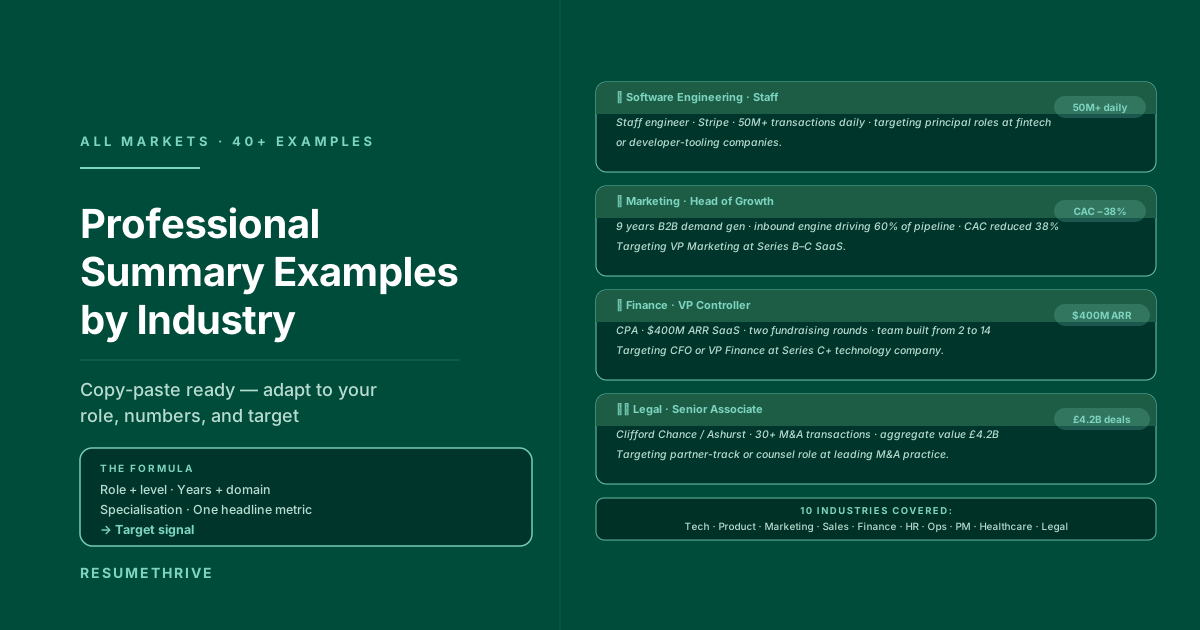
💻 Software Engineering
I build distributed systems that scale. Senior backend engineer with 9 years across fintech and infrastructure — currently at Stripe, where I lead a team owning real-time payment settlement for 50M+ transactions/day. Previously at Square and a Y Combinator fintech where I scaled the core ledger from zero to $2B in annual volume. Open to staff/principal engineering roles at growth-stage startups or mission-driven fintechs.
📊 Product Management
I turn messy product strategy into clear roadmaps and shipped features. Senior PM with 7 years in B2B SaaS — currently at HubSpot owning the CRM core product for 200k+ business customers. Led three 0-to-1 launches; two are now top-5 revenue features. I specialise in discovery, prioritisation under constraint, and working with enterprise sales cycles. Exploring director-level PM roles at Series C+ companies.
📣 Marketing
I run demand gen that actually generates demand. Head of Growth at two B2B SaaS companies — reduced average CAC by 38% and built the inbound engine that drove 60% of pipeline at my last company. Background spans paid, content, and lifecycle. I'm particularly good at the messy middle: inheriting a broken funnel and making it work before adding budget. Looking for VP Marketing roles at Series B–C SaaS.
⚖️ Finance / Accounting
CPA with 11 years in financial reporting and controllership, most recently as VP Controller at a $400M ARR SaaS company through two fundraising rounds and a near-IPO process. I've built finance teams from scratch, implemented NetSuite twice, and closed two sets of audited financials under pressure. Open to CFO or VP Finance roles at high-growth technology companies Series C and beyond.
Common mistakes
What kills LinkedIn summary performance
-
⚠️
Leaving it blank. An empty About section tells a recruiter nothing and costs you search ranking. Even 3–4 lines is better than nothing, and nothing is the current state for more profiles than you'd expect.
-
⚠️
Writing in third person. "John is an experienced leader who…" reads like a press release and signals the summary was written by someone else, or pasted from a bio. First person is warmer, more credible, and more readable.
-
⚠️
Making the hook generic. The first two lines are all most people read. If yours opens with "I am a results-driven professional…" you've already lost the recruiter who has forty more profiles to look at.
-
⚠️
No call to action at the end. The most common missed opportunity on LinkedIn. Tell people what you're open to and what the next step is. Recruiters won't guess — they'll move to the next candidate.
-
⚠️
Copying your resume bullet points directly. Your LinkedIn summary is not a list of job duties. It's a pitch. It should sound different to your resume — more personal, more direct, and more forward-looking.
Final check
LinkedIn summary checklist
Before you publish
- First two lines stand alone as a compelling hook — test by reading just those and asking: would I click "see more"?
- Written in first person throughout — no "she is" or "John brings"
- Contains your exact job title, industry, and 2–3 key tool or methodology names for search ranking
- Includes at least 2 specific achievements with numbers
- Zero buzzwords — no "passionate," "dynamic," "results-driven," "thought leader"
- Ends with a clear signal of what you're looking for or open to
- Total length: 200–300 words — enough to be substantive, short enough to be read
- Read aloud once — if any sentence sounds like it was written by a robot, rewrite it
One last step
Make sure your resume backs up your LinkedIn profile
A strong LinkedIn summary gets the recruiter interested. Your resume closes the deal. Run a free ATS scan to make sure your resume has the right keywords and structure to match the story you're telling on LinkedIn.
Get my free ATS score → Free · No sign-up · Instant results