July 20, 2026


- Home
- Services
- Resume Example
- Resume Review
- Reverse Recruiting
- BlogJuly 19, 2026July 18, 2026July 17, 2026July 16, 2026July 15, 2026July 14, 2026July 13, 2026
- Contact Us
What Is ATS and How Does It Score Your Resume?

Get A Professional Resume Review

Get A Professional Resume Services

Get in Touch With Experienced Writer
Home » ATS Resume » What Is ATS and How Does It Score Your Resume?
What Is ATS and How Does It Score Your Resume?
You apply for a job. Your resume disappears. No response, no rejection — nothing. Most job seekers blame bad luck. The real culprit is a piece of software that made the decision before any human got involved.
Applicant Tracking Systems — ATS for short — are the invisible gatekeepers of the modern hiring process. Understanding exactly how they work is the single most useful thing you can do for your job search right now.
Want to know your ATS score before your next application? Get a free scan in 60 seconds.
Check my resume free →The basics
What ATS software actually is
An ATS is a database and screening system rolled into one. Companies use it to collect applications, store candidate information, and — crucially — filter out resumes that don't meet their criteria automatically.
When you apply online, your resume doesn't land in a recruiter's inbox. It gets parsed by software: the text is extracted, broken into fields (name, contact, work history, skills, education), and scored against the job requirements. Only the resumes that clear the threshold get flagged for a human to review.
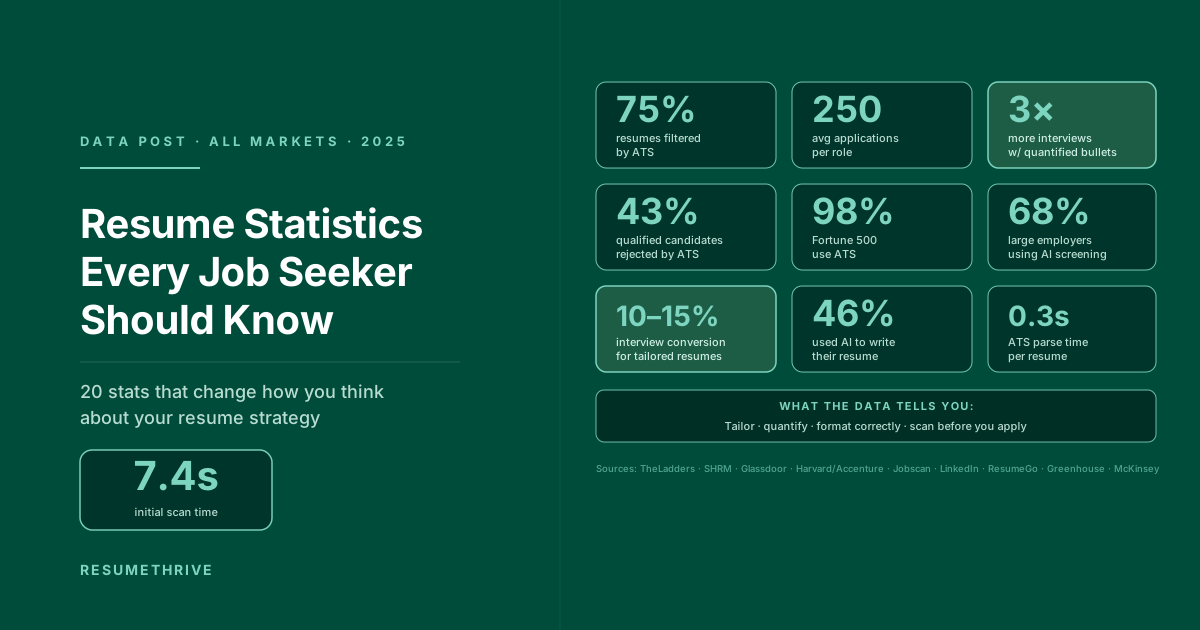
75%
of resumes are rejected by ATS before a recruiter ever reads them — not because the candidate was unqualified, but because the resume wasn't formatted or worded in a way the software could process correctly.
Who uses it
The platforms you're up against
There are dozens of ATS platforms, but a handful dominate the market. Each has slightly different parsing rules, but all share the same core logic.
Workday
Widely used by enterprise companies and large corporates globally
Taleo
Oracle-owned, dominant in Fortune 500 and government hiring
Greenhouse
Popular with tech companies and fast-growing startups
iCIMS
Common in retail, healthcare, and high-volume hiring sectors
Lever
Favourite of mid-size tech and SaaS companies
BambooHR
Frequently used by small to mid-sized businesses in all industries
You rarely know which system a company uses — which is exactly why your resume needs to be optimised for all of them, not just one.
Free ATS resume scanner
See how your resume scores right now
Upload your resume and get an instant compatibility score — with the specific issues flagged and how to fix them.
Get my free ATS score → Free · No sign-up · Results in 60 secondsThe process
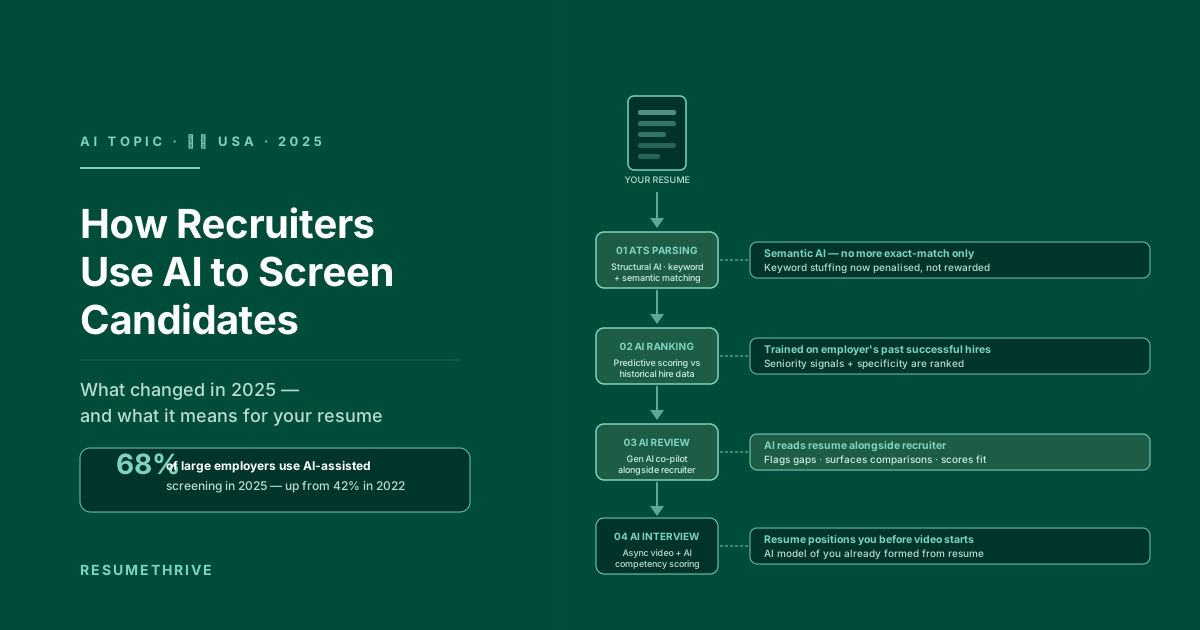
How ATS scores your resume — step by step
- Parsing — the software reads your file The ATS extracts all text from your resume and tries to sort it into structured fields: name, email, phone, job titles, employers, dates, skills, education. Any formatting it can't read (tables, columns, graphics) gets mangled or skipped entirely.
- Keyword matching — your words vs. the job description The system compares your resume against the job posting's required skills, titles, and qualifications. The more your language matches the posting's exact phrasing, the higher your relevance score.
- Criteria filtering — hard requirements are checked Some filters are binary. Required degree? Required certification? Required years of experience? If you don't meet a hard filter, your application is automatically excluded regardless of your overall score.
- Ranking — you're sorted against every other applicant Your resume is scored relative to other applicants for the same role. The top-ranked resumes get flagged for human review. The rest are archived.
- Human review — finally, a person Only at this stage does a recruiter get involved — and only for the resumes the ATS surfaced. Everyone else never gets seen.
The scorecard
What ATS software weighs most heavily
Not all factors carry equal weight. Here's how a typical ATS prioritises its scoring:
Keyword match with job description
Critical
Job title relevance
High
Hard requirements met
High
Formatting & parseability
Med
Skills section completeness
Med
Education credentials
Low
Weighting varies by platform and role — but keyword match is the dominant factor across every major ATS.
Know your score before you apply — our free scanner checks all of this in one go.
Scan my resume free →What this means for you
Four rules every ATS-ready resume follows
-
Use the job posting's exact language
Don't paraphrase. If the posting says "stakeholder management," your resume should say "stakeholder management" — not "managing relationships with stakeholders." The ATS is doing exact or near-exact string matching, not reading for meaning.
-
Keep the format simple and linear
One column, standard fonts, no headers or footers with important information, no text boxes. Section headings should be conventional: Work Experience, Education, Skills — not creative alternatives the parser won't recognise.
-
Lead with a skills section
ATS systems parse top to bottom. A dedicated skills section placed early in your resume ensures your most relevant keywords are captured even if deeper sections get mis-parsed.
-
Never rely on a single version of your resume
Each application needs a version tailored to that specific posting. At minimum, update your summary and skills to reflect the role's language. Generic resumes score lower on every job they're sent to.
Action plan
Your ATS-readiness checklist
Before every application
- Read the job posting and list the exact keywords used for skills and qualifications
- Add those keywords verbatim to your skills section and relevant bullet points
- Use a single-column layout with conventional section headings
- Save as .docx or a text-based PDF — never an image or design-tool export
- Confirm all required certifications and credentials are clearly listed
- Run the resume through an ATS scanner before submitting
One last step
Check your ATS score before your next application
Our free scanner analyses your resume against ATS criteria and tells you exactly what to fix — in 60 seconds, no sign-up needed.
Get my free ATS score → Free · No sign-up · Instant results