July 20, 2026


- Home
- Services
- Resume Example
- Resume Review
- Reverse Recruiting
- BlogJuly 19, 2026July 18, 2026July 17, 2026July 16, 2026July 15, 2026July 14, 2026July 13, 2026
- Contact Us
How Recruiters Use AI to Screen Candidates in 2025

Get A Professional Resume Review

Get A Professional Resume Services

Get in Touch With Experienced Writer
Home » ATS Resume » How Recruiters Use AI to Screen Candidates in 2025
How Recruiters Use AI to Screen Candidates in 2025
Most job seekers know about ATS — the software that keyword-scans resumes before a human ever sees them. What fewer people realise is that ATS is no longer the only automated layer between your application and a recruiter's inbox. In 2025, AI tools have been layered on top of, underneath, and alongside traditional ATS at every stage of the screening process.
This isn't a scare story — it's a map. Understanding how these tools actually work, what signals they're trained to look for, and where in the process they operate gives you a significant advantage over candidates who are still optimising for a screening process that no longer exists in its original form.
Start by finding out how your resume scores against AI and ATS screening filters right now.
Scan my resume free →The shift
What changed — and when
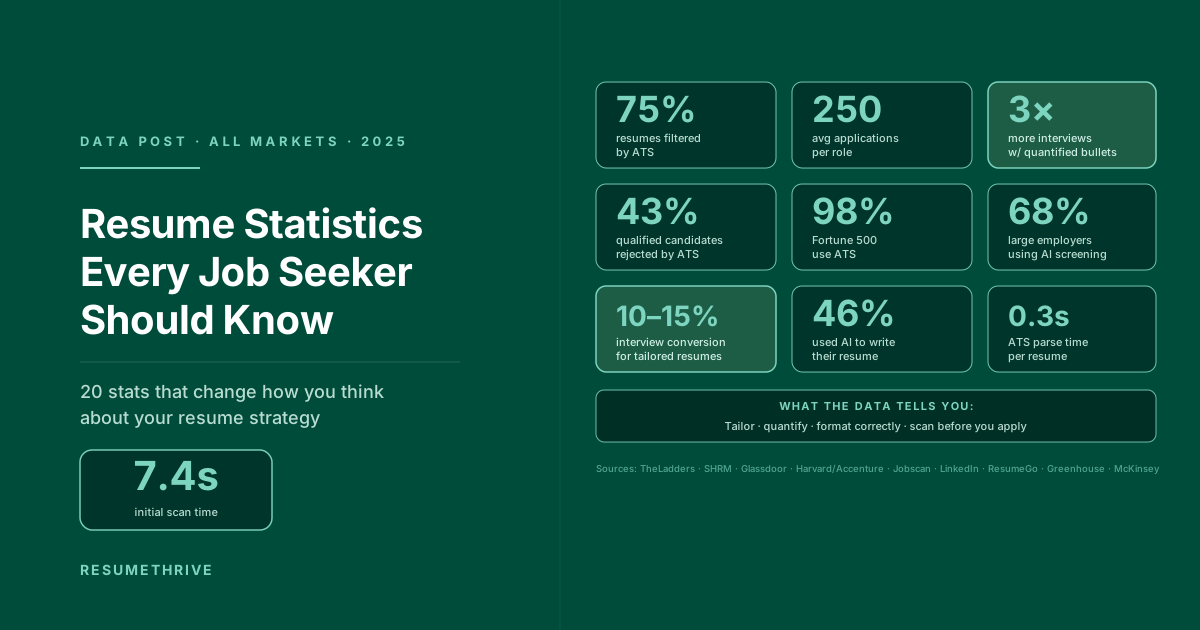
68%
of large employers now use some form of AI-assisted screening in their hiring process, according to 2025 SHRM data — up from 42% in 2022. The shift accelerated after large language models became commercially viable, enabling recruiters to automate not just keyword matching but qualitative judgements about candidate fit, experience relevance, and likely performance.
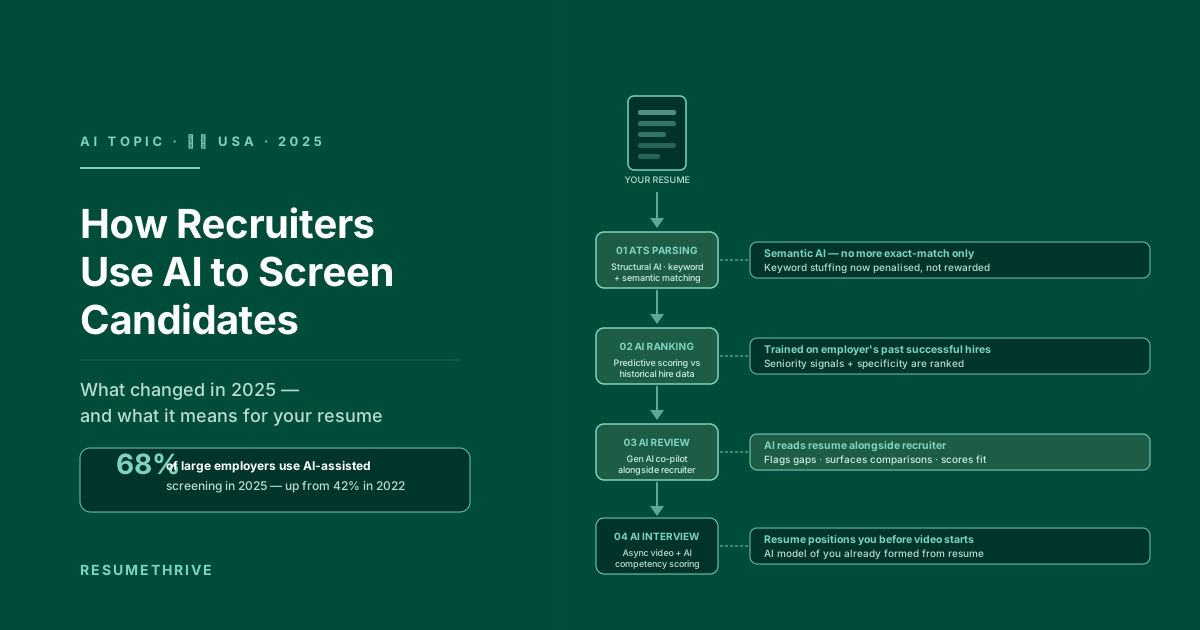
The important distinction to understand is that AI screening in 2025 doesn't just operate at the ATS layer. It operates at multiple points in the pipeline — some before a human sees your resume, some during the review itself, and some in the interview stage. Each layer has different implications for how you present yourself.
The AI screening pipeline
Where AI touches the hiring process in 2025
-
Initial ATS parsing — structural AI
The first layer is still the most widespread. Modern ATS platforms (Workday, Greenhouse, Lever, iCIMS) have integrated AI into their parsing engines, which now go beyond keyword matching to assess semantic relevance. This means a resume that says "built and shipped product features" might match a job description that says "product development" — even without exact keyword overlap. But it also means these systems are better at identifying keyword stuffing: pasting 50 keywords into white text no longer works.
-
Candidate ranking and scoring — predictive AI
Several enterprise ATS platforms now use predictive AI to rank candidates before a recruiter opens a single resume. These models are typically trained on the employer's historical hiring data — who they previously hired, how those hires performed, and what resume signals correlated with those outcomes. The practical implication: your resume needs to not just pass a keyword filter but score well on a relevance ranking that you can't fully see.
-
AI resume review assistants — generative AI
A growing category: AI tools that sit alongside a recruiter during manual review, surfacing insights, flagging potential concerns, and generating summaries of each candidate. Tools like HireVue's AI review assistant, Beamery, and Eightfold.ai read the resume alongside the recruiter and prompt questions, comparisons, or scoring adjustments. In this layer, the AI is less a gatekeeper and more a co-pilot — but one whose biases and weightings affect which candidates get the deepest human attention.
-
Job description matching — semantic similarity AI
Some platforms now automatically score resumes against job descriptions using semantic similarity models rather than keyword lists. This approach scores how conceptually similar your experience is to the role — even when the words differ. A resume describing "managed a team of engineers to deliver features" might score well against a job posting asking for "engineering leadership and product delivery," even though no single keyword matches. What this means for candidates: specificity and relevance of experience description matters more than keyword density.
-
AI-generated interview screening — conversational AI
Beyond the resume, many companies now use asynchronous video interview tools (HireVue, Spark Hire, Talview) that incorporate AI analysis of verbal responses, speech patterns, and content alignment with role requirements. Some screen for specific competencies automatically. While these tools operate after resume screening, performing well at the resume stage gets you into this layer — and understanding it exists should inform how you describe your experience on paper, since the AI has already built a model of you before the video interview begins.
Free ATS resume scanner
See how your resume scores against AI screening filters
Our free scanner checks keyword coverage, specificity signals, and formatting against the same ATS and AI filters major employers use — in 60 seconds.
Get my free ATS score → Free · No sign-up · Results in 60 secondsWhat AI screening looks for
The signals AI screening is trained to evaluate
Understanding what AI screening systems are actually measuring is more useful than trying to "game" them — and more durable, since the signals that correlate with good hires are genuinely the same signals that make your resume readable to humans.
✓ Signals AI rewards
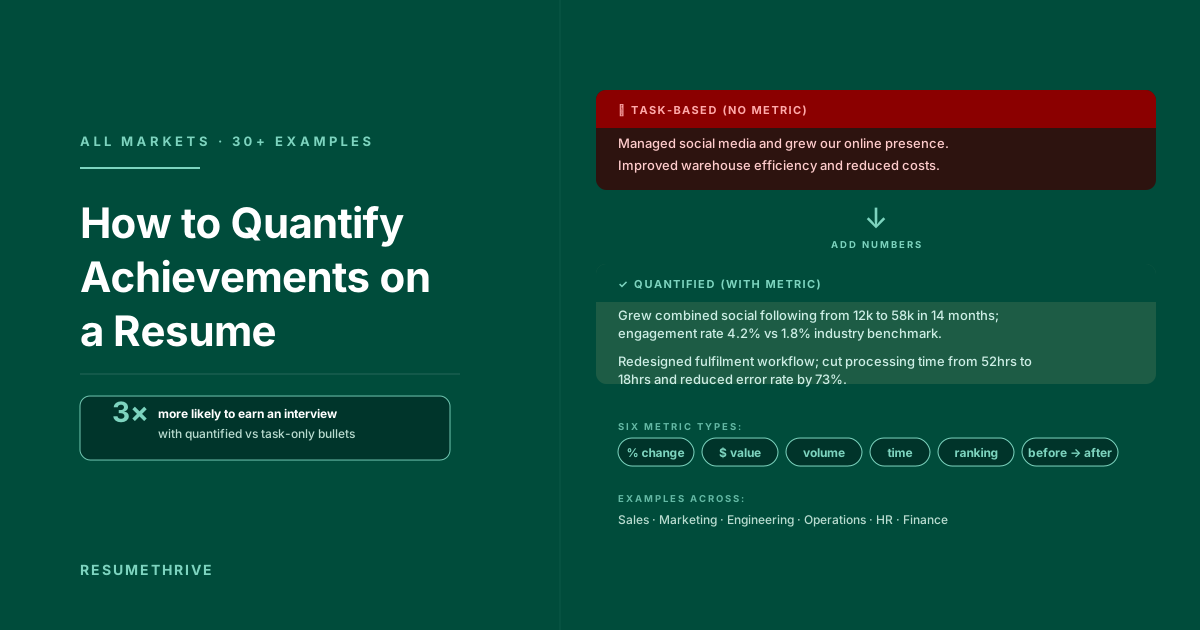
- Specific, quantified accomplishments (not vague claims)
- Named tools and technologies used professionally
- Job title and employer relevance to the target role
- Consistent career progression and tenure
- Industry-native vocabulary throughout
- Outcome-focused language (reduced, grew, delivered)
- Clear seniority signals (team size, budget, scope)
✕ Signals AI penalises
- Keyword stuffing without supporting context
- Generic filler language (results-driven, passionate)
- Unexplained employment gaps
- Very short tenures across multiple roles
- Formatting that breaks parsing (tables, columns)
- Claims without evidence (no numbers, no scale)
- Mismatched seniority signals vs target role level
The bias problem
What candidates should know about AI screening bias
AI hiring tools have been the subject of significant regulatory scrutiny in recent years, and for good reason. Models trained on historical hiring data can encode and amplify existing biases — favouring candidates from certain educational institutions, penalising non-linear career paths, or disadvantaging names associated with underrepresented groups.
Several US states and New York City specifically have passed legislation requiring employers to audit AI hiring tools for bias before deployment. The EU AI Act classifies AI recruitment tools as "high risk" requiring transparency and human oversight. These regulatory developments don't eliminate the issue, but they've prompted more reputable platforms to invest in bias mitigation — and they give candidates recourse when they suspect unfair automated screening.
For individual job seekers, the practical implication is: document everything. If you're applying to roles where your qualifications clearly match and receiving no responses over a sustained period, automated screening bias may be a factor. Many companies now offer the right to request human review of AI screening decisions.
Not getting responses despite strong qualifications? Check your resume against AI screening signals first.
Scan my resume free →Resume strategy for AI screening
What this means for how you write your resume
The good news is that optimising for AI screening and optimising for human readers are not conflicting goals — they point to exactly the same approach. The same signals that AI models reward (specificity, evidence, relevance, clarity) are the same signals that make a resume compelling to read. Chasing AI optimisation through keyword stuffing is actively counterproductive, because semantic AI models now detect and discount it.
Specific quantified outcomes
Named tools by exact product name
Role-relevant vocabulary throughout
Clear seniority signals
Consistent employment narrative
ATS-safe formatting (no tables)
No keyword stuffing
No filler adjectives
No hidden text tricks
Common mistakes
What gets resumes filtered by AI screening in 2025
-
⚠️
Keyword stuffing. Pasting job description keywords in white text, cramming them into a skills section without context, or repeating them unnaturally. Semantic AI models have been specifically trained to detect and discount this pattern — it now actively hurts your score.
-
⚠️
Formatting that breaks AI parsing. Multi-column layouts, embedded tables, graphics, and text boxes are still a problem for AI parsing layers, just as they were for traditional ATS. Plain single-column formatting remains the safest approach across all screening systems.
-
⚠️
Vague, unquantified claims. AI scoring models trained on successful hires increasingly weight specificity signals. "Led a high-performing team to deliver exceptional results" scores lower than "Led a team of 12 engineers to reduce deployment time from 3 weeks to 4 days."
-
⚠️
Mismatched role levels. Applying for senior roles with junior-level signals (small teams, limited budget, short tenures) creates a relevance mismatch that AI ranking systems flag — even when keyword coverage is high. Seniority signals need to be visible and consistent throughout.
Final check
Resume checklist for AI-screened hiring in 2025
Optimise for AI and human readers simultaneously
- Every major claim supported by a specific number or scale indicator
- Named tools listed by exact product name (Salesforce, not "CRM software")
- Industry-native vocabulary throughout — not generic corporate language
- No keyword stuffing — keywords appear naturally within evidence-backed bullets
- Single-column, ATS-safe formatting — no tables, columns, or graphics
- Seniority signals consistent with target role (team size, budget, scope)
- Employment narrative clear — any significant gaps briefly contextualised
- Resume tailored to the specific role, not a generic version applied everywhere
- Run through ATS and AI keyword scanner before every application
One last step
Check how your resume scores against AI and ATS screening
Our free scanner checks keyword coverage, specificity signals, and formatting across the same filters that AI-enhanced ATS systems use in 2025 — before you apply.
Get my free ATS score → Free · No sign-up · Instant results