July 20, 2026


- Home
- Services
- Resume Example
- Resume Review
- Reverse Recruiting
- BlogJuly 19, 2026July 18, 2026July 17, 2026July 16, 2026July 15, 2026July 14, 2026July 13, 2026
- Contact Us
How to Quantify Achievements on a Resume (With Examples)

Get A Professional Resume Review

Get A Professional Resume Services

Get in Touch With Experienced Writer
Home » ATS Resume » How to Quantify Achievements on a Resume (With Examples)
How to Quantify Achievements on a Resume (With Examples)
"Managed a team" and "managed a team of 14 engineers across three time zones, reducing average release cycle from 6 weeks to 11 days" describe the same job. One gets an interview. The other gets archived. The difference is a number.
Quantifying achievements is the single highest-leverage change most people can make to a resume. It doesn't require rewriting everything — just knowing which questions to ask about the work you've already done. This guide covers the exact framework, the six types of metric that work across every industry, and 30+ real before/after examples so you can apply it to your own experience immediately.
Once you've added your metrics, check how your resume scores on ATS keyword matching.
Scan my resume free →Why numbers work
Why metrics change how recruiters read your resume
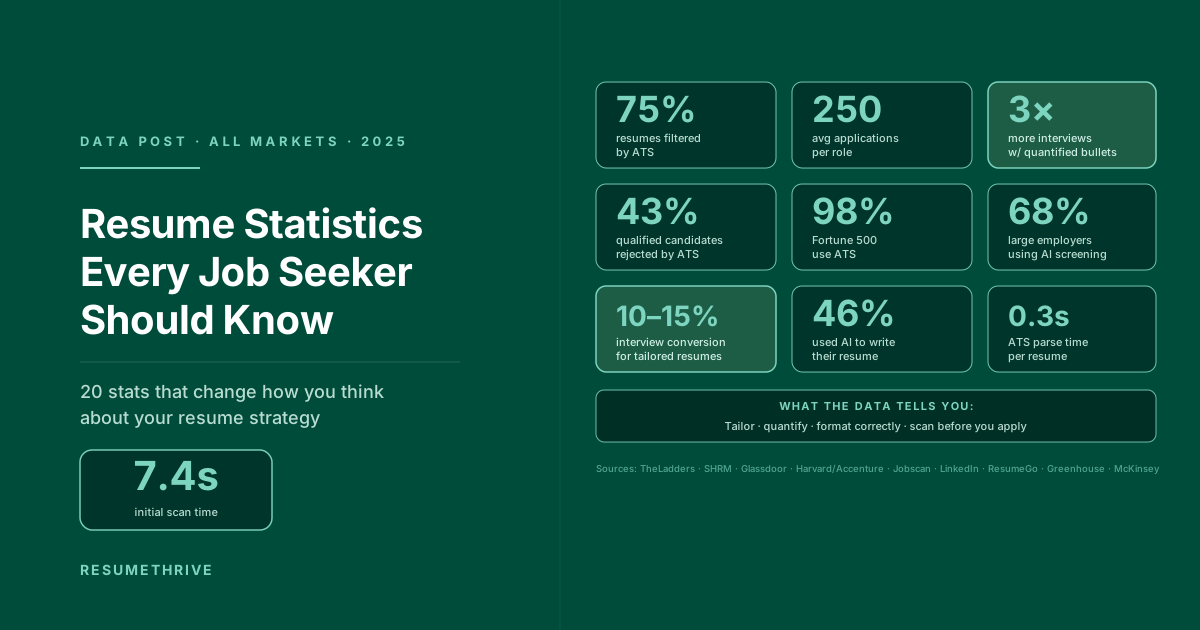
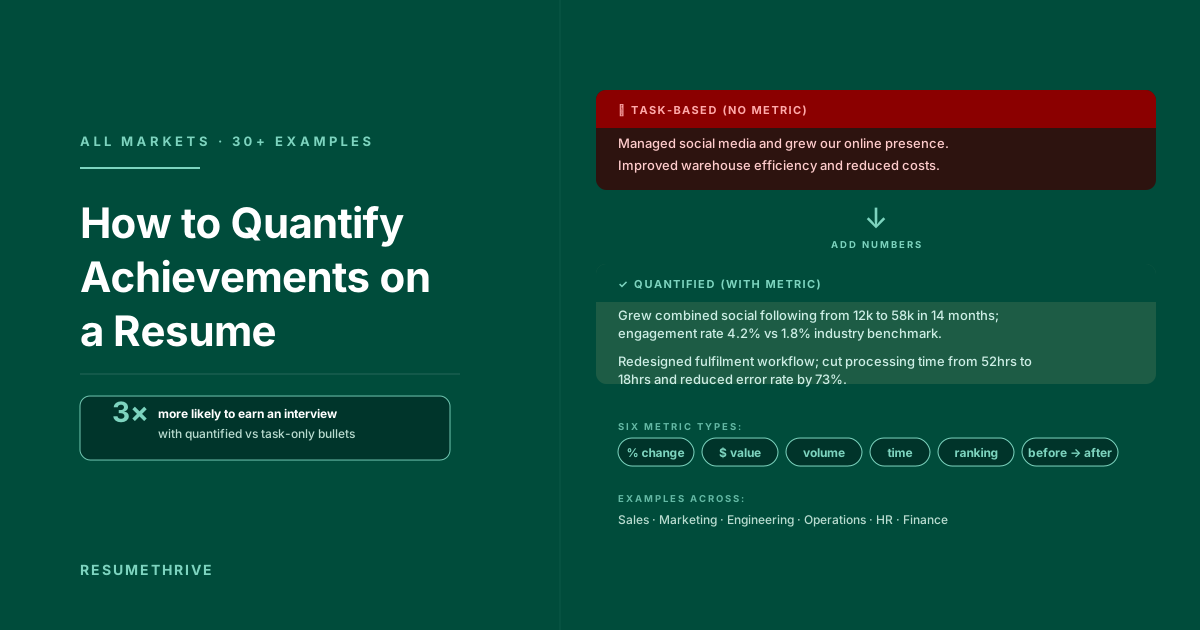
3×
more likely to earn an interview — resumes with quantified achievements versus those using only task-based descriptions, according to multiple hiring platform studies. Numbers do something that words alone can't: they make a claim testable. "Significantly improved sales" is an assertion. "Increased sales by 34% in Q3" is evidence.
Recruiters are trained to be sceptical of unqualified claims. Adjectives like "significant," "substantial," "major," and "impactful" appear in almost every resume they read — and because everyone uses them, they carry no information. A number, by contrast, is specific. It forces the reader to picture the actual scale of what you did, and it sets you apart from every candidate who described the same work without one.
Six types of metric
The six metric categories that work across every industry
%
Percentage change
Increased, reduced, improved by X% — the most universal metric type
$
Revenue and cost
Revenue generated, cost saved, budget managed, deal value
#
Volume and scale
Users, clients, team size, locations, SKUs, transactions
⏱
Time
Reduced time by X days/hours, delivered X weeks ahead, cycle time
🏆
Rankings and ratings
NPS score, customer satisfaction, review ratings, award placements
↑
Before/after
From X to Y — shows trajectory when a raw number alone lacks context
The framework
How to find your numbers — five questions to ask yourself
-
How big was it?
Team size, budget, client count, transaction volume, geographic scope — scale answers the question "how much did you handle?" even when you can't measure the outcome directly. "Managed a portfolio of 40 enterprise accounts" is better than "managed enterprise accounts."
-
How much did it change?
Before and after comparisons are the clearest way to show impact. If something improved under your watch — conversion rate, response time, headcount, revenue — find the starting point and the endpoint. Even approximate figures ("from roughly 20% to 35%") are more credible than no figure at all.
-
How fast did it happen?
Time context makes numbers more impressive. "Reduced onboarding time by 40%" is good. "Reduced onboarding time by 40% in 8 weeks" is better — it implies pace and execution capability, not just eventual outcome.
-
How did it compare to the target or baseline?
Exceeding a target or beating a benchmark tells a recruiter you didn't just do the job — you did it well. "Exceeded quarterly sales target by 23%" says more than "achieved quarterly sales target." "Ranked top 5% of all account managers globally" says more than "high performer."
-
What would have happened without it?
Sometimes the metric is a cost averted or a risk mitigated rather than a gain achieved. "Identified and resolved a billing discrepancy that would have cost the company £180,000" is a strong achievement even though nothing visibly improved — something bad was prevented. These count too.
Free ATS resume scanner
Check your quantified resume against ATS filters
Metrics improve your appeal to human readers. Keywords improve your score with ATS. Our free scanner checks both — in 60 seconds, no sign-up required.
Get my free ATS score → Free · No sign-up · Results in 60 seconds30+ examples by industry
Before and after — quantified resume bullets by field
📊 Sales and business development
Sales rewrites
Responsible for managing key client accounts and growing revenue.
Managed a portfolio of 22 enterprise accounts worth $4.8M ARR; expanded average contract value by 31% through upsell campaigns in Q2 and Q3.
Consistently met and exceeded sales targets throughout my tenure.
Exceeded annual quota by 118% for three consecutive years; ranked 2nd of 47 account executives globally in FY2023.
Developed and maintained relationships with new and existing customers.
Sourced and closed 14 net-new enterprise logos in 10 months, contributing $2.1M in new ARR — 40% above target.
📣 Marketing
Marketing rewrites
Managed social media accounts and grew our online presence.
Grew combined social following from 12k to 58k in 14 months through organic content strategy; average engagement rate 4.2% vs industry benchmark of 1.8%.
Ran paid advertising campaigns across multiple channels.
Managed £320k paid media budget across Google and Meta; reduced average CPA from £48 to £27 while maintaining conversion volume.
Created email marketing campaigns to engage our customer base.
Redesigned lifecycle email programme for 180k subscribers; open rate increased from 18% to 34%, driving £420k in attributed revenue over 6 months.
💻 Engineering and technology
Engineering rewrites
Led development of a new API that improved performance.
Architected and shipped a REST API handling 12M requests/day; reduced average latency from 340ms to 42ms — an 88% improvement.
Worked on improving the deployment process and reducing bugs.
Introduced CI/CD pipeline and automated test coverage from 34% to 91%; reduced production incidents by 60% and deployment frequency from monthly to daily.
Managed a team of engineers to deliver projects on time.
Led a team of 9 engineers to deliver a real-time payments feature 3 weeks ahead of schedule; adopted by 2,400+ enterprise clients in the first quarter.
📦 Operations and supply chain
Operations rewrites
Improved warehouse efficiency and reduced costs.
Redesigned pick-and-pack workflow for a 40,000 sq ft distribution centre; reduced average fulfilment time from 52 hours to 18 hours and cut error rate by 73%.
Managed supplier relationships and procurement processes.
Renegotiated contracts with 12 key suppliers; achieved $1.4M in annual savings against a $9M procurement budget without reducing service levels.
👥 People and HR
HR rewrites
Managed the recruitment process and reduced time-to-hire.
Redesigned recruitment process for 6 high-volume roles; reduced average time-to-hire from 47 days to 19 days and cut agency spend by £180k annually.
Implemented employee engagement initiatives that improved satisfaction.
Launched quarterly engagement programme across 400-person organisation; eNPS improved from +12 to +41 over 18 months, with voluntary attrition falling from 22% to 14%.
💰 Finance and accounting
Finance rewrites
Prepared financial reports and managed the month-end close process.
Owned month-end close for a $120M revenue business; reduced close cycle from 12 to 5 days by implementing automated reconciliation across 8 entities.
Identified cost saving opportunities across the business.
Led a zero-based budgeting review that identified $3.2M in addressable cost savings; $2.1M implemented within 12 months without headcount reduction.
Added your metrics? Run a free ATS scan to check keyword coverage before you apply.
Scan my resume free →When you don't have the numbers
What to do when you genuinely can't find a metric
Not every achievement has a clean, accessible number behind it. You may not have tracked it, the data may belong to a previous employer you can't contact, or the work may simply not be the type that produces measurable outputs. Here's how to handle each case:
-
💡
Use scale proxies instead. If you can't measure the outcome, measure the scope. "Managed a team" → "managed a 12-person team." "Oversaw the budget" → "oversaw a $2M annual budget." The number doesn't have to be an improvement — it just has to be specific.
-
💡
Use approximate ranges honestly. "Reduced processing time by approximately 30–40%" is more credible than "significantly reduced processing time" — and it signals you're trying to be accurate, not overclaiming. Recruiters respect honest approximations.
-
💡
Use frequency instead of magnitude. If you can't measure how much, measure how often. "Presented to the board quarterly" or "reviewed 50+ applications per week" gives scale without requiring outcome data.
-
💡
Describe the counterfactual. "Identified a billing error that would have resulted in a £240k overcharge" is a valid quantified achievement — the number is real even though the money was never actually lost. Saved costs and avoided losses count.
Final check
Resume metrics checklist
Before you submit
- At least 60% of bullet points include a specific number, range, or scale indicator
- No unquantified adjectives: "significantly," "substantially," "greatly," "major" — replace with numbers
- Each number answers at least one of: how big, how much, how fast, vs target, vs baseline
- Where exact figures aren't available, approximate ranges or scale proxies used instead
- Currency figures include the correct symbol ($ / £ / € / CAD) for the target market
- Large numbers formatted clearly: $1.4M not $1,400,000; 12k not 12,000 (unless precision matters)
- Before/after format used where the trajectory is more meaningful than the end state alone
One last step
Make sure your metrics pass the ATS filter too
A quantified resume impresses human readers. Our free scanner ensures it also passes the keyword and formatting filters that determine whether a human ever sees it.
Get my free ATS score → Free · No sign-up · Instant results