
July 20, 2026


- Home
- Services
- Resume Example
- Resume Review
- Reverse Recruiting
- BlogJuly 19, 2026July 18, 2026July 17, 2026July 16, 2026July 15, 2026July 14, 2026July 13, 2026
- Contact Us
Cybersecurity Analyst Resume: Complete Guide 2025 (USA)

Get A Professional Resume Review

Get A Professional Resume Services

Get in Touch With Experienced Writer
Home » ATS Resume » Cybersecurity Analyst Resume: Complete Guide 2025 (USA)
Cybersecurity Analyst Resume: Complete Guide 2025 (USA)
Cybersecurity is one of the most in-demand fields in the US job market — and one of the most ATS-filtered. Hiring managers use certification and tool names as hard filters before reading a single line. If your resume doesn't have the right keywords in the right places, it never reaches a human.
This guide covers exactly how to structure a cybersecurity analyst resume in 2025 — the sections that matter, the keywords ATS systems filter for, how to write bullet points that prove your impact, and the mistakes that get even qualified candidates filtered out.
Already have a cybersecurity resume? Run a free ATS scan and see your keyword match score in 60 seconds.
Scan my resume free →The market
What the cybersecurity job market looks like in 2025
3.5M
unfilled cybersecurity jobs globally — yet qualified candidates still get filtered out by ATS systems daily because their resume doesn't match the keyword profile that hiring managers set. Demand is high; resume quality is the differentiator.
Cybersecurity roles range from SOC Analyst (Tier 1–3) and Penetration Tester to GRC Analyst, Threat Intelligence Analyst, Cloud Security Engineer, and CISO. Each has a distinct keyword profile. A resume written for a SOC Analyst role will score poorly on a Cloud Security Engineer posting if it's not tailored — even if the candidate has relevant experience in both.
The other critical factor: certifications are hard filters. CISSP, CEH, CompTIA Security+, CISM, and AWS Security Specialty are not nice-to-haves at most companies — they're binary requirements. If you hold one and it's not clearly visible on your resume, you're being screened out by the ATS before a human ever sees your name.
ATS keywords
The cybersecurity keywords that ATS systems filter for
Keywords marked in darker green appear in the highest volume of cybersecurity job postings and are most commonly used as ATS filters.
Certifications — list every one you hold, both abbreviated and in full:
CISSP CompTIA Security+ CEH CISM CISA AWS Security Specialty OSCP CySA+ GIAC / GSEC PenTest+
Core skills and concepts — these are the highest-frequency ATS keywords:
Incident response Threat intelligence Vulnerability assessment SIEM SOC operations Penetration testing Zero trust Firewall management IAM NIST framework Risk assessment DLP Endpoint detection Network security Cloud security Threat hunting Security architecture
Tools — list every platform and tool you've used by exact name:
Splunk CrowdStrike Microsoft Sentinel Palo Alto Networks Nessus Wireshark Metasploit Qualys IBM QRadar Darktrace SentinelOne Tenable.io Okta CyberArk
Free ATS resume scanner
See which cybersecurity keywords your resume is missing
Upload your resume and get an instant keyword gap report — matched against the role you're targeting.
Get my free ATS score → Free · No sign-up · Results in 60 secondsResume structure
How to structure a cybersecurity analyst resume in 2025
-
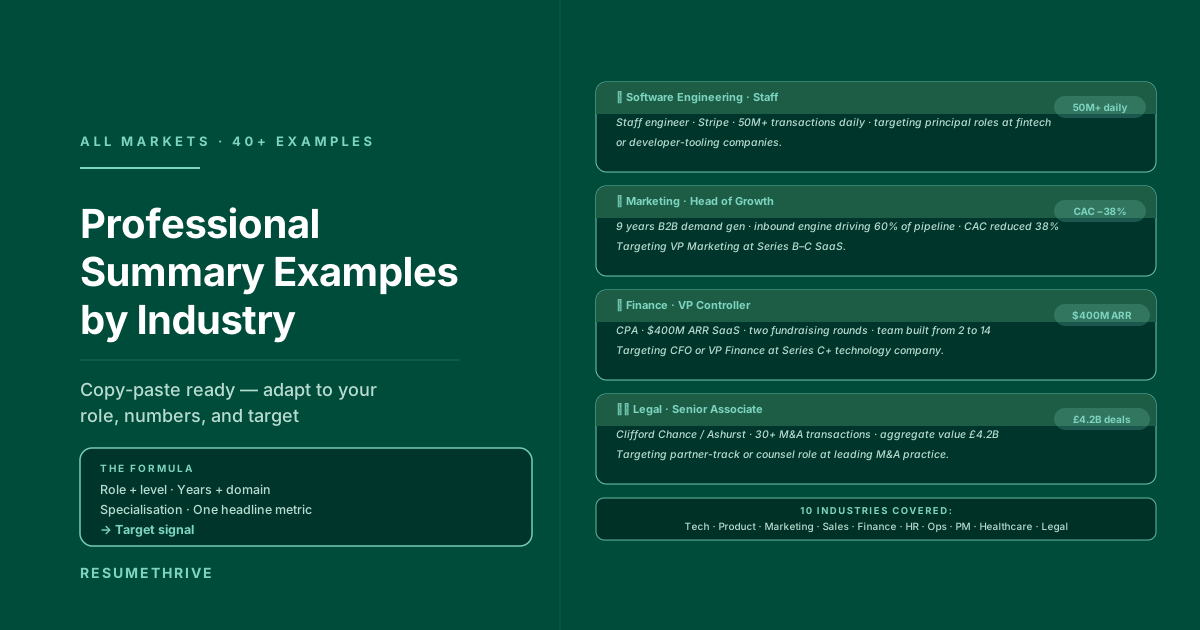
Professional Summary (3–4 lines at the top)
Your summary is the first thing both ATS and the recruiter reads. It needs to state your role title, years of experience, two or three of your highest-value skills, and a key credential — all in the first two lines. ATS systems weigh keywords that appear early in the document more heavily.
Example — professional summaryExperienced security professional with a background in protecting organisational assets and responding to security incidents.Cybersecurity Analyst with 6 years of SOC experience specialising in incident response, threat intelligence, and SIEM operations (Splunk, Microsoft Sentinel). CISSP-certified. Reduced mean time to detect by 40% at current employer through implementation of automated threat hunting workflows. -
Certifications (immediately after summary)
In cybersecurity, certifications are often the first thing a recruiter checks after the summary — and ATS systems use them as hard filters. Place them in a dedicated section immediately below your summary, above your work history. List each certification with the issuing body and year obtained.
FormatCISSP — ISC² (2022) · CompTIA Security+ (2020) · AWS Security Specialty (2023) -
Technical Skills section
List every relevant tool, platform, framework, and technology by name. This is pure keyword territory — ATS systems scan this section specifically. Organise by category: SIEM Platforms, Endpoint Security, Network Security, Cloud Security, Frameworks. Don't use rating bars or visual scales — they're invisible to ATS.
Example skills section formatSIEM: Splunk, Microsoft Sentinel, IBM QRadar · EDR: CrowdStrike Falcon, SentinelOne · Network: Palo Alto, Wireshark, Nessus · Frameworks: NIST CSF, MITRE ATT&CK, ISO 27001 · Cloud: AWS Security, Azure Defender -
Work Experience — achievement-led bullet points
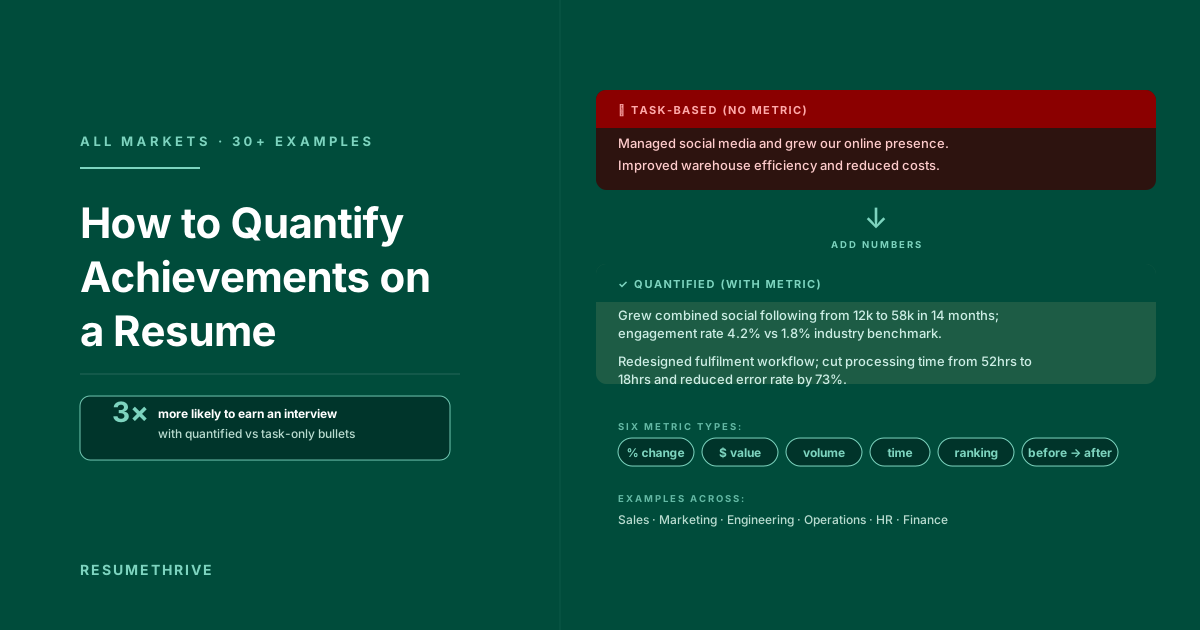
Every bullet point needs to show what you did and what it resulted in. Cybersecurity is a metrics-rich field — response times, reduction percentages, number of incidents handled, vulnerabilities remediated, uptime percentages. If a bullet doesn't have a number, it's a candidate for rewriting.
Bullet point rewrite examplesResponsible for monitoring security alerts and responding to incidents.Monitored 15,000+ daily security alerts via Splunk SIEM, triaging and resolving 98% within SLA — reducing mean time to respond (MTTR) from 4.2 hours to 47 minutes over 12 months.Performed vulnerability assessments across the organisation.Conducted quarterly vulnerability assessments using Tenable.io across 2,400 endpoints, identifying and coordinating remediation of 340+ critical CVEs — reducing organisational risk score by 62%. -
Education
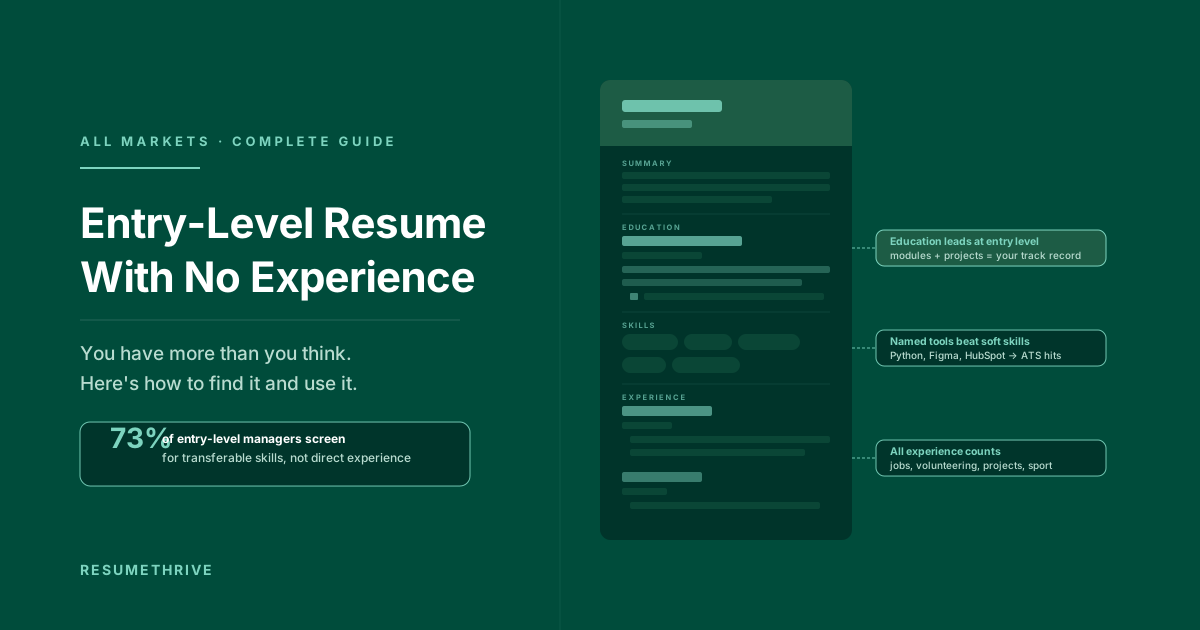
A relevant degree (Computer Science, Information Security, Cybersecurity) strengthens your profile but is rarely a hard filter compared to certifications. List degree, institution, and graduation year. If you have a strong certification stack, education becomes secondary — put certs first.
Common mistakes
What gets cybersecurity resumes rejected
- ⚠️
Certifications buried in the education section. ATS systems sometimes fail to parse certifications correctly when they're mixed with degree information. Give certifications their own dedicated section, placed high on the page.
- ⚠️
Listing tools in a two-column layout. Skills listed across two columns get scrambled by most ATS parsers. The system reads left-to-right across the whole page, mixing your tools with your frameworks and rendering the section unreadable.
- ⚠️
Using only abbreviations or only full names for certifications. Some ATS systems search for "CISSP" while others search for "Certified Information Systems Security Professional." Use both — write "CISSP (Certified Information Systems Security Professional)" on first mention.
- ⚠️
Duty-based bullet points with no metrics. "Monitored network activity" tells a recruiter nothing. Every bullet point in a cybersecurity resume should answer: what scale, what tool, what outcome? Numbers are not optional in this field.
- ⚠️
Not tailoring for the specific role type. A SOC Analyst resume should emphasise alert triage, incident response, and SIEM operations. A Penetration Tester resume should lead with tools (Metasploit, Burp Suite), methodologies, and engagement scope. Using one resume for all cybersecurity roles consistently underperforms.
Built your cybersecurity resume? Run it through our free ATS scanner before you submit.
Scan my resume free →By role type
How the resume changes by cybersecurity specialisation
SOC Analyst (Tier 1–3): Lead with SIEM platforms, alert volume handled, MTTR/MTTD metrics, escalation procedures, and playbook development. Tier 2 and above should show progression from alert triage to threat hunting and forensics.
Penetration Tester / Ethical Hacker: Tools are the priority — Metasploit, Burp Suite, Nmap, Kali Linux, Cobalt Strike. Lead with engagement types (web app, network, red team), methodologies (PTES, OWASP), and findings delivered. OSCP is a critical credential at this level.
GRC Analyst: Frameworks are central — NIST CSF, ISO 27001, SOC 2, HIPAA, PCI-DSS. Emphasise audit experience, risk register management, policy development, and compliance programme ownership. Less tools, more process.
Cloud Security Engineer: AWS, Azure, GCP security services lead the skills section. Certifications (AWS Security Specialty, Azure Security Engineer Associate) are often hard filters. Show infrastructure-as-code security, identity management, and zero-trust architecture experience.
Threat Intelligence Analyst: OSINT tools, threat actor profiling, IOC analysis, dark web monitoring, and intelligence report writing. Platforms like Recorded Future, Mandiant, and MISP should appear. Show how intelligence directly influenced security decisions.
Final check
Cybersecurity resume checklist before you apply
Run through this before every application
- Professional summary states role title, years of experience, and 2–3 top credentials in the first two lines
- All certifications in a dedicated section — both abbreviated and full name
- Technical skills section organised by category — no columns, no rating bars
- Every tool and platform listed by exact product name
- Every work bullet point includes scale, tool used, and measurable outcome
- Keywords mirrored from the specific job posting
- Single-column layout, standard fonts, .docx or text-based PDF format
- Run through ATS scanner before submitting
One last step
Check your cybersecurity resume against ATS in 60 seconds
Our free scanner checks keyword coverage, formatting, and certification visibility — and tells you exactly what to fix before your next application.
Get my free ATS score → Free · No sign-up · Instant results