
July 20, 2026


- Home
- Services
- Resume Example
- Resume Review
- Reverse Recruiting
- BlogJuly 19, 2026July 18, 2026July 17, 2026July 16, 2026July 15, 2026July 14, 2026July 13, 2026
- Contact Us
Product Manager Resume: Keywords and Examples 2025 (USA)

Get A Professional Resume Review

Get A Professional Resume Services

Get in Touch With Experienced Writer
Home » ATS Resume » Product Manager Resume: Keywords and Examples 2025 (USA)
Product Manager Resume: Keywords and Examples 2025 (USA)
Product management is one of the hardest roles to write a resume for — because the job itself is hard to define. PMs sit between engineering, design, and business, and a resume that describes what you "managed" or "led" without showing outcomes gets filtered out fast, by both ATS and the humans who see it.
This guide covers the exact keywords, resume structure, and bullet point frameworks that get PM resumes past ATS and into the hands of hiring managers in 2025 — with real before/after examples across experience levels.
Already have a PM resume? Run a free ATS scan and see your keyword match score in 60 seconds.
Scan my resume free →The PM hiring landscape
What makes the PM resume uniquely difficult
400+
applications per open PM role at mid-to-large tech companies in 2025. ATS systems filter the majority before a recruiter sees a single name. The PMs who get through combine the right keywords with outcome-driven bullet points that prove business impact.
The core tension: PM work is collaborative and cross-functional by nature, which makes it tempting to describe it vaguely — "worked with engineering to deliver…" or "collaborated with stakeholders to…". Vague language scores poorly on ATS keyword matching and fails to impress technical hiring managers who know exactly what PMs should be accountable for.
The fix is simple: own the outcome, not the activity. You didn't "work with engineering" — you "defined the technical requirements and roadmap for a feature that increased conversion by 22%." You didn't "collaborate with stakeholders" — you "aligned 6 stakeholder groups across 3 business units on a product strategy that delivered $4.2M in new ARR within 9 months."
ATS keywords
The PM keywords ATS systems filter for in 2025
Core PM methodology and process keywords — highest ATS frequency:
Product roadmap Go-to-market Agile Scrum Sprint planning Stakeholder management User research A/B testing OKRs KPIs MVP Product discovery Prioritisation PRD Feature flagging Jobs to be done Customer journey
Metrics — the words that signal PM credibility to both ATS and humans:
ARR / MRR NPS DAU / MAU Conversion rate Retention Churn CSAT LTV CAC Revenue impact
Tools — list every platform you use professionally by exact name:
Jira Figma Amplitude Mixpanel SQL Productboard Confluence Looker Tableau Intercom Pendo Notion Miro Segment LaunchDarkly
Free ATS resume scanner
See which PM keywords your resume is missing
Upload your resume and get an instant keyword gap report — matched against the product management role you're targeting.
Get my free ATS score → Free · No sign-up · Results in 60 secondsResume structure
How to structure a PM resume in 2025
-
Professional Summary — role, domain, and one headline metric
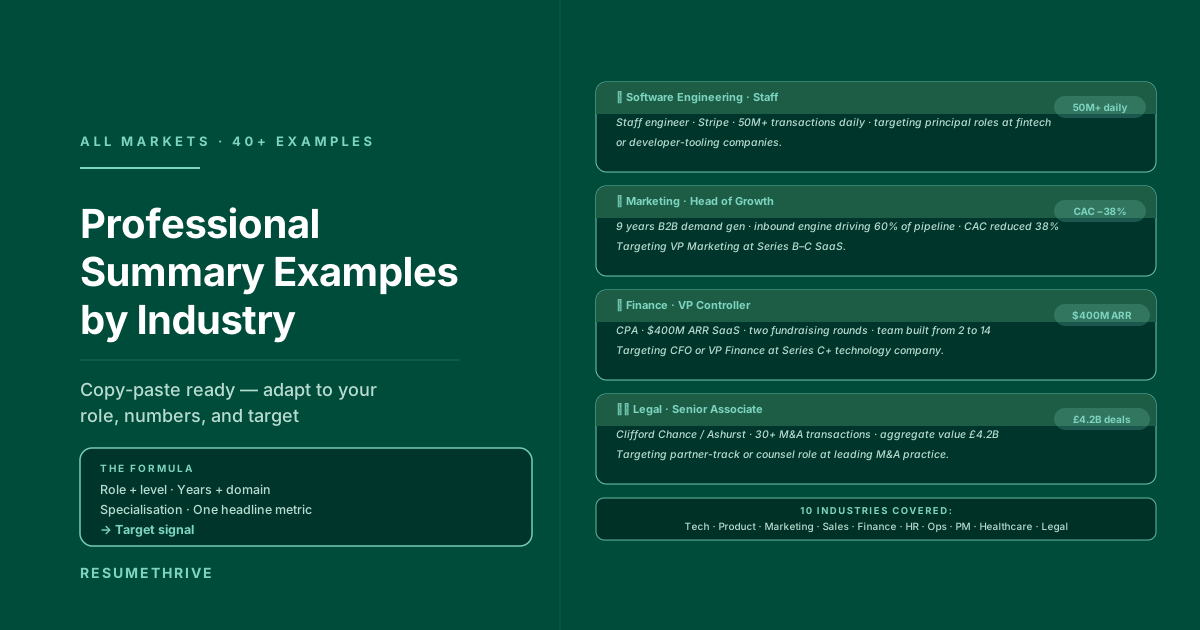
Your summary needs to tell the recruiter what type of PM you are, what domain you've worked in, and one signal of scale or impact. "Product Manager with 6 years of experience" tells them nothing. "Senior PM with 6 years building B2B SaaS products in fintech — led 0-to-1 launch of a payment reconciliation feature adopted by 800+ enterprise clients and driving $6M ARR" tells them everything they need to forward your resume.
Summary rewriteProduct Manager with 6 years of experience in SaaS companies, skilled in Agile methodologies and cross-functional collaboration.Senior PM with 6 years in B2B SaaS (fintech, payments). Led 0-to-1 launch of payment reconciliation product adopted by 800+ enterprise clients — contributing $6M ARR in year one. Expert in roadmap definition, stakeholder alignment, and SQL-based analytics (Amplitude, Looker). -
Core Skills — keywords first, tools second
PM skills sections should lead with methodology keywords (product roadmap, A/B testing, OKRs, user research) followed by tools (Jira, Amplitude, SQL, Figma). This order maximises ATS keyword matching because methodology terms appear more frequently in job descriptions than specific tool names. Use a flat, single-column list — no columns, no icons.
Skills section formatProduct strategy · Roadmap planning · Agile / Scrum · A/B testing · User research · Stakeholder management · OKRs · Go-to-market · Jira · Amplitude · Figma · SQL · Looker · Productboard -
Work Experience — the Impact Bullet framework
Every PM bullet point needs to answer three questions: what did you ship, what problem did it solve, and what happened as a result? The temptation is to describe the process. The hire-worthy version describes the outcome. Use specific metrics wherever possible — conversion rate, revenue, DAU, NPS, time saved. If you don't have a metric, describe the scale: number of users, enterprise clients, markets, or team size.
Bullet rewritesLed development of a new onboarding flow with the engineering and design team.Defined and shipped a redesigned onboarding flow (3-month sprint, 4 engineers, 2 designers) — increased trial-to-paid conversion from 18% to 31% and reduced time-to-first-value from 14 days to 3 days.Managed the product roadmap and prioritised features based on customer feedback.Owned product roadmap for the core analytics suite — prioritised backlog of 120+ requests using RICE scoring and customer interviews, shipping 3 major features in Q3 that drove a 14-point NPS increase and $1.8M in expansion revenue.Worked with stakeholders across the business to align on the product vision.Aligned 8 stakeholders across sales, engineering, finance, and legal on a revised product vision — resolved 4 competing priorities through structured trade-off analysis and secured executive sign-off in 3 weeks, unblocking a $2.4M enterprise deal. -
Education and Certifications
A relevant degree (CS, business, design) is useful context but rarely a differentiator at the PM level. If you hold a CSPO, PSPO, PMC, or MBA, list it clearly — some ATS systems use these as filters for senior roles. If you've completed relevant courses (Reforge, Product School, Lenny's), these are worth including for roles at companies where that training is valued.
PM types
How the resume changes by PM specialisation
📱 Consumer / B2C PM
- Lead with DAU, MAU, retention, engagement
- A/B testing and growth experimentation
- App store ratings, user reviews
- Tools: Amplitude, Mixpanel, Firebase
🏢 Enterprise / B2B PM
- Lead with ARR, enterprise clients, NPS
- Stakeholder and customer advisory boards
- Implementation and onboarding metrics
- Tools: Salesforce, Gainsight, Pendo
⚙️ Platform / Technical PM
- API adoption, developer experience
- System uptime, latency, scalability
- Technical roadmap and architecture
- SQL proficiency often expected
🚀 Growth PM
- Lead with conversion, CAC, LTV, funnel
- Experimentation velocity and win rate
- Paid and organic acquisition impact
- Tools: Segment, LaunchDarkly, Looker
Common mistakes
What gets PM resumes rejected
- ⚠️
Activity-based bullet points with no outcomes. "Managed the roadmap," "led sprint planning," and "collaborated with engineering" are activities. They tell the recruiter you did the job — not that you did it well. Every bullet needs a result.
- ⚠️
No metrics anywhere on the resume. A PM resume with zero numbers is a significant red flag. If you genuinely don't have access to metrics, use scale proxies — number of users affected, team size, number of markets, deal size unblocked. Something is always measurable.
- ⚠️
Claiming credit for team outcomes without specifying your role. "Our team shipped X and achieved Y" removes you from the story. Recruiters want to understand your specific contribution. "I defined the requirements and led stakeholder alignment for X" is clearer and more credible.
- ⚠️
No mention of tools. Tool proficiency (Jira, Amplitude, SQL, Figma) is increasingly screened as a hard filter at tech companies. If you use these tools daily and they're not on your resume, you're failing keyword filters for roles you're qualified for.
- ⚠️
Generic summary that applies to every PM role. "Experienced PM with a passion for building great products" applies to 100,000 people. Your summary needs to state your domain (B2B SaaS, consumer mobile, fintech), your level (associate, senior, principal, director), and one headline metric or achievement.
Updated your PM resume? Run a free ATS scan to confirm your keyword coverage before you apply.
Scan my resume free →By company type
What changes by employer
FAANG and big tech: Scale and data fluency dominate. SQL proficiency is expected, not optional. Metrics need to be large — millions of users, multi-million dollar revenue impact. System thinking and cross-functional leadership at scale are the primary hiring signals.
Series A–C startups: Ownership and velocity. Show that you can work with ambiguity, make decisions without perfect data, and wear multiple hats. 0-to-1 launch experience is highly valued. Less emphasis on process, more on outcomes shipped.
Enterprise SaaS: Stakeholder complexity and customer relationships. NPS, CSAT, and enterprise client retention metrics resonate. Experience navigating sales cycles and working with customer success teams is a differentiator.
AI / ML product roles: A growing category in 2025. Keywords like "LLM integration," "model evaluation," "AI product strategy," and "responsible AI" are increasingly appearing as filters. Technical fluency — understanding model limitations, latency constraints, and evaluation frameworks — is now expected at senior levels.
Final check
PM resume checklist before you apply
Run through this before every application
- Summary states PM type, domain, experience level, and one headline metric
- Skills section leads with methodology keywords, followed by tools — no columns
- Every bullet point answers: what shipped, what problem solved, what result
- At least 60% of bullets include a specific metric or scale indicator
- All tools used professionally are listed by exact name
- Keywords mirror the specific job posting's language
- No "we" language — all bullets are written in first-person implied ("Led…" not "We led…")
- Single-column layout, .docx or text-based PDF format
- Run through ATS scanner before submitting
One last step
Check your PM resume against ATS in 60 seconds
Our free scanner checks keyword coverage, formatting, and how your resume scores against the product management role you're targeting — before you apply.
Get my free ATS score → Free · No sign-up · Instant results