
July 20, 2026


- Home
- Services
- Resume Example
- Resume Review
- Reverse Recruiting
- BlogJuly 19, 2026July 18, 2026July 17, 2026July 16, 2026July 15, 2026July 14, 2026July 13, 2026
- Contact Us
10 Resume Formatting Mistakes That Confuse ATS (Canada)

Get A Professional Resume Review

Get A Professional Resume Services

Get in Touch With Experienced Writer
Home » ATS Resume » 10 Resume Formatting Mistakes That Confuse ATS (Canada)
10 Resume Formatting Mistakes That Confuse ATS (Canada)
Your resume looks great. Clean fonts, clear sections, good experience. And yet — it never reaches a recruiter. The problem usually isn't what you wrote. It's how the file is structured.
ATS software doesn't read resumes the way humans do. It parses them — extracting raw text and sorting it into fields. When the formatting gets in the way, the content gets scrambled, skipped, or scored as incomplete. These 10 mistakes are the most common reasons it happens.
10
formatting errors account for the majority of ATS rejections in Canada — and every single one of them is fixable before your next application goes out.
Not sure which of these your resume has? Our free ATS scanner finds them in 60 seconds.
Scan my resume free →The mistakes
10 formatting errors that confuse ATS — and how to fix each one
-
Using a two-column or multi-column layout
Very commonEasy fixATS parsers read left to right, top to bottom — like a single column of text. A two-column layout causes the parser to mix content from different columns together, turning your work history and skills into scrambled nonsense.
Fix: Switch to a single-column layout. All content flows in one vertical stream. -
Putting contact details in the header or footer
Very commonEasy fixMost ATS software cannot read content placed in Word's header or footer areas. Your name, email, and phone number go into the void — meaning the recruiter who does see your resume has no way to contact you.
Fix: Place all contact information in the main body of the document, not in a header/footer field. -
Using text boxes and tables for layout
CommonEasy fixText boxes and tables look clean in Word or PDF, but ATS parsers either skip them entirely or extract the content out of order. Skills listed in a table are often completely missed.
Fix: Use plain paragraph text and line breaks. No tables, no text boxes, no shapes. -
Saving from a design tool like Canva or Adobe
Very commonEasy fixDesign tools export PDFs where text is embedded as vector paths or images — not selectable text. To an ATS, the file is blank. Your entire resume scores zero because no content can be extracted.
Fix: Build your resume in Microsoft Word or Google Docs and export from there. -
Using unusual or creative section headings
CommonEasy fixATS systems are trained to recognise standard headings: "Work Experience," "Education," "Skills." Creative alternatives like "Where I've Been" or "My Toolkit" confuse the parser — it doesn't know where to file the content that follows.
Fix: Use conventional headings only. Work Experience, Education, Skills, Certifications, Summary. -
Including photos, logos, or icons
CommonEasy fixImages are invisible to ATS. Worse, they can disrupt the text flow around them, causing nearby content to be parsed incorrectly. In Canada, photos on resumes are also generally discouraged to avoid unconscious bias.
Fix: Remove all images, icons, and logos. Text only. -
Using non-standard fonts
ModerateEasy fixDecorative or uncommon fonts can cause character encoding issues during parsing, turning your carefully written bullet points into garbled symbols or missing text.
Fix: Stick to system fonts — Calibri, Arial, Helvetica, Georgia, or Times New Roman. -
Writing dates in inconsistent or non-standard formats
ModerateEasy fixATS software uses date fields to calculate tenure and sort work history. Mixing formats (Jan 2022, 01/22, 2022-01) or using vague entries like "Recent" confuses the parser and can result in your timeline being read incorrectly.
Fix: Use a consistent format throughout — "Month Year" (e.g. January 2022) or "MM/YYYY" works reliably. -
Listing skills only as a visual chart or rating bar
CommonEasy fixSkill bars — those horizontal graphic indicators showing "90% proficiency in Excel" — are images. The ATS reads nothing. Your skills section effectively disappears, costing you all the keyword matches those skills would have generated.
Fix: List skills as plain text, comma-separated or bulleted. No ratings, no bars, no graphics. -
Not tailoring the resume to the job posting
Very commonHigh impactThis isn't a formatting mistake in the traditional sense — but it's the most impactful one. A generic resume doesn't match the keyword profile of any specific posting. Even a perfectly formatted resume scores low if the language doesn't reflect the role.
Fix: Mirror the job posting's exact language for skills, tools, and job titles in your resume.
Free ATS resume scanner
Find out which of these mistakes your resume has
Upload your resume and get an instant ATS compatibility report — with specific issues flagged and fixes explained.
Get my free ATS score → Free · No sign-up · Results in 60 secondsA note for Canadian job seekers
Does any of this differ in Canada?
Mostly no — ATS software works the same way regardless of which country the company is in. But there are a few Canada-specific things worth knowing:
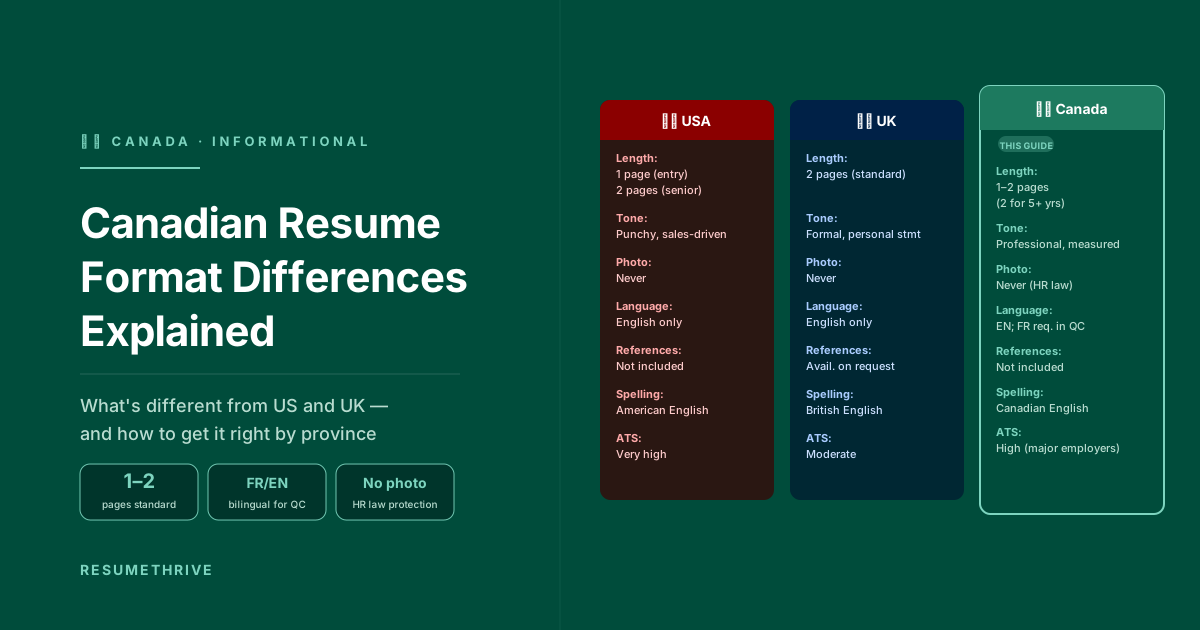
CV vs. resume: In Canada, "resume" and "CV" are often used interchangeably, but the standard for most jobs is a 1–2 page resume, not a full academic CV. Use the term the job posting uses.
Bilingual requirements: If a role is posted in both English and French — particularly for federal government or Quebec-based positions — submit separate versions optimised for each language. One bilingual document does not rank well in either language's keyword search.
No photos or SIN numbers: Never include a Social Insurance Number or a photo on a Canadian resume. This applies both to ATS systems and human reviewers.
Ready to fix your resume? Start with a free ATS scan to see exactly where you stand.
Check my resume free →Before you apply
ATS formatting checklist for Canadian job seekers
Run through this before every submission
- Single-column layout — no tables, text boxes, or columns
- Contact info in the document body, not in a header or footer
- Saved as .docx or text-based PDF from Word or Google Docs
- Standard fonts only — Calibri, Arial, Georgia
- Conventional section headings — Work Experience, Skills, Education
- No photos, icons, logos, or skill rating bars
- Dates in a consistent format throughout
- Skills listed as plain text, not graphics
- Language tailored to the specific job posting
- Run through an ATS scanner before submitting
One last step
Check your resume against every one of these mistakes
Our free ATS scanner catches formatting issues, missing keywords, and everything else that's holding your resume back — in under a minute.
Get my free ATS score → Free · No sign-up · Instant results